Le Creuset: the lighter pot you can see into
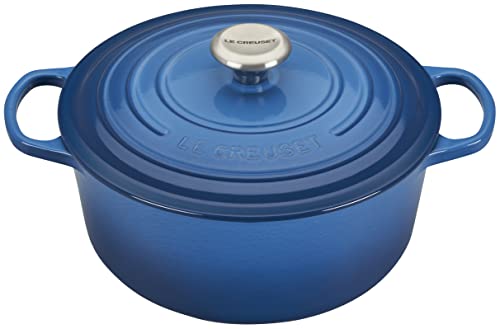
Both are made in France, both carry lifetime warranties and both will outlast you. The differences are about a pound and a quarter, the color of the inside and what the lid does.
Tap either one to check today’s price.
Le Creuset: the lighter pot you can see into
Staub: the heavier pot for long braises

Staub has the edge on 2 of 10 lines, Le Creuset on 1, 4 even.
| Feature | Le Creuset | Staub |
|---|---|---|
| Price, 5.5 qt on Amazon | About $455 | About $330 to $425, depending on color (the edge) |
| Weight with lid | 11 lb 3.5 oz (America's Test Kitchen) (the edge) | 12 lb 8.4 oz (America's Test Kitchen) |
| Interior | Sand-colored glossy enamel | Black matte enamel |
| Lid | Tight-fitting, smooth underside | Heavy flat lid with self-basting spikes |
| Knob | Stainless steel, safe at any oven temperature | Nickel steel |
| Oven safe | To 500°F | Pot to 900°F without the lid; lid to 500°F (the edge) |
| InductionEven | Yes | Yes |
| DishwasherEven | Safe per the listing | Safe; hand washing recommended |
| WarrantyEven | Limited lifetime | Limited lifetime |
| Made inEven | France | France |
The verdict
Buy the Le Creuset if you bake bread, lift the pot often or want to see the fond as it browns. Buy the Staub if you braise more than you bake and want an interior that still looks the same in twenty years.
The Dutch oven for sourdough bread.The cookware you do not have to wonder about.The cast iron skillet for a glass top stove.
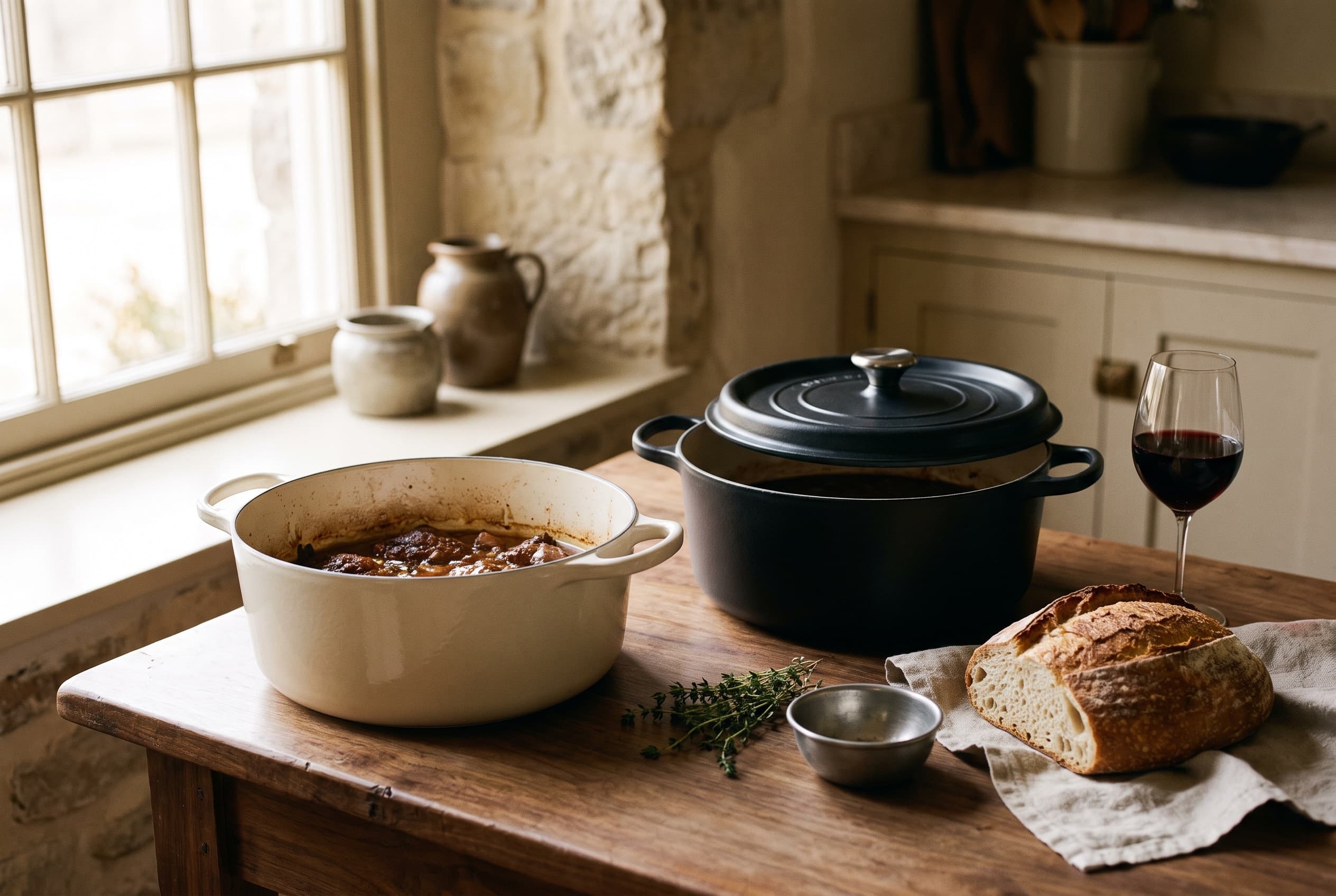
Le Creuset and Staub make the two enameled cast iron pots most people end up choosing between. Le Creuset has cast in northern France since 1925. Staub has made cocottes in Alsace since 1974 and is now owned by Zwilling. At 5.5 quarts, the size most households should buy, they cost within about $100 of each other and cook more alike than the arguments suggest.
What separates them is practical. Le Creuset's interior is a pale, glossy enamel and the pot is lighter. Staub's is a black matte enamel inside a heavier pot, with small spikes under the lid that drip condensation back onto the food. One is built to be watched, the other to be left alone for three hours.
America's Test Kitchen weighed both in its Dutch oven testing: 11 pounds 3.5 ounces for the Le Creuset, 12 pounds 8.4 ounces for the Staub. It named the Le Creuset its winner at 5 to 6 quarts and recommended the Staub. Below is the rest of the comparison, and two alternatives for anyone who would rather not spend $300 or more.
The lighter of the two, with a pale interior that shows exactly when the fond is ready.
The pale sand interior is the reason to choose it. You can see browning happen, see a scorch coming before it arrives, and judge how far a sauce has reduced. America's Test Kitchen credited the light interior and low, straight sides with making browning easy to monitor, and made this pot its winner in the 5 to 6 quart class.
It is also the lighter pot, by about a pound and a quarter in ATK's weighing. That sounds small until the pot is full, or until you are lifting it out of a 450 degree oven twice for every loaf of bread. The looped handles take an oven mitt, and the stainless steel knob is safe at any oven temperature, so no-knead bread is no trouble.
Skip it if you want the inside to look new forever. A light interior stains with years of use and needs the occasional paste of baking soda. It will cook just as well stained, but some owners mind.
The catch. The pale interior stains with use, and the warranty excludes damage from thermal shock and overheating.
Where to buy
AmazonCheck price →Heavier and darker, with a spiked lid made for braises that cook for hours with the lid on.
Staub's interior is a textured black matte enamel. Staub says the texture gives exceptional browning, and it has a second virtue: there is nothing pale to stain, so a twenty-year-old Staub looks much like a new one. The trade is that you cannot see the fond as clearly. America's Test Kitchen found the dark interior made it a touch harder to tell when beef had browned.
The lid is heavy and flat, with small spikes underneath that collect condensation and drip it back onto the food, which Staub calls a rain-forest effect. For stews and braises that spend hours in the oven, owners report less need to top up liquid. The pot itself is rated to 900 degrees Fahrenheit without the lid, and the lid to 500, so it will take any oven temperature a home cook uses.
Skip it if you bake bread several times a week. The extra weight, about 12 and a half pounds with the lid, is felt every time a hot pot comes out of the oven.
The catch. Heavier than the Le Creuset, and the black interior makes browning harder to judge by eye.
Where to buy
AmazonCheck price →A French-made pot with a light interior and a dimpled lid, for less than either of the two houses.

Made In's Dutch oven is made in France and sold direct by a younger company, which is most of why it costs less. It borrows from both sides of this comparison: a light interior like Le Creuset's and a lid with small dimples underneath, which Made In calls the Cloud Cover Lid, that returns condensation to the food the way Staub's spikes do.
America's Test Kitchen recommended it and praised a cooking surface nearly as broad as its favorite 7 quart pot. It is heavier than either French classic in ATK's weighing, 12 pounds 15 ounces, and Made In says to wash it by hand.
The catch. The heaviest 5.5 quart pot here, with a much shorter track record on the secondhand market.
Where to buy
AmazonCheck price →Cooks much like the French pots for about a fifth of the price. The enamel is where the savings come from.

On the stove, cast iron is cast iron, and Lodge's imported enameled pot browns and braises much like pots four or five times the price. It is rated to 500 degrees Fahrenheit, works on induction, and the listing calls it dishwasher safe while recommending hand washing. America's Test Kitchen recommended the 6 quart and noted its low sides made it easy to see into.
The compromise is the enamel, which owners report chips more readily than the French makers' at the rim and on the cooking surface. For a first Dutch oven, or a second one kept for bread at high heat, that is an easy risk to accept at this price.
The catch. Enamel durability is the known compromise, and it is heavier than the Le Creuset.
Where to buy
AmazonCheck price →For bread, the Le Creuset. It is lighter to lift in and out of a hot oven, and the knob will not mind the heat. For short ribs, coq au vin and anything that braises for hours with the lid on, the Staub's spiked lid and forgiving black interior are the better tools.
For browning onions or a roux, where color is everything, a pale interior tells you more. Staub owners learn to cook by smell and by the sound of the pan, and many prefer it. Neither is a mistake.
Both makers offer a limited lifetime warranty, and both exclude the thing most likely to end a pot: thermal shock. A hot pot plunged into cold water, or an empty pot heated hard on a high flame, can craze or chip the enamel, and neither maker covers that. Heat gradually, let it cool before it meets the sink, and keep metal tools off the rim.
Buy from an authorized seller. Staub's US warranty applies to purchases from authorized sellers, and a pot bought secondhand is generally on its own.
Both makers price by color, and the same pot can differ by $100 or more on Amazon depending on the finish. If you are not attached to a color, check two or three before buying.
Neither across the board. Le Creuset is lighter and easier to read while cooking; Staub is heavier, hides wear and has a lid built for long braises. America's Test Kitchen named the Le Creuset its winner at 5 to 6 quarts and recommended the Staub.
Staub. America's Test Kitchen weighed the 5.5 quart Staub at 12 pounds 8.4 ounces and the 5.5 quart Le Creuset at 11 pounds 3.5 ounces, both with lids.
Yes. Le Creuset casts in Fresnoy-le-Grand in northern France; Staub is made in France and owned by Zwilling.
Most bakers prefer the Le Creuset for its lighter weight. The Staub pot is rated to 900 degrees Fahrenheit without its lid, but its lid is rated to 500, the same as the Le Creuset.
No. Staub's black matte interior is enamel, not bare iron, and needs no seasoning. It does build a slight patina with use.
 KitchenHexClad vs Henckels Paradigm: Which Hybrid Pan to Buy
 KitchenLe Creuset vs Caraway Dutch Oven: Which to Buy
 KitchenBest Revolving Cake Stand for Decorating
 KitchenBest Cast Iron Skillet for a Glass Top Stove
 KitchenBest Chef's Knife Under $100: Five Worth Buying
 KitchenBest Cutting Board for Raw Meat and Poultry
 KitchenBest Cutting Board: End Grain vs Edge Grain Wood
 KitchenThe Best Meat Thermometers: Instant-Read and Leave-In
The Bonwits Letter
What is worth buying for the house this week, what is actually on sale, and what to skip. Short, and never sponsored.

