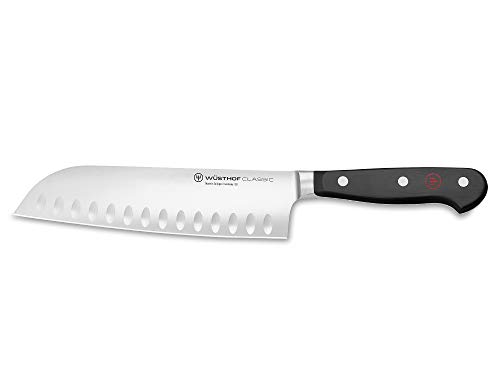
The Wusthof
Two Solingen makers, two forged 8 inch chef's knives, and fewer differences than the price tags suggest. The ones that remain are about weight, handle and who sharpens it.
Tap either one to check today’s price.
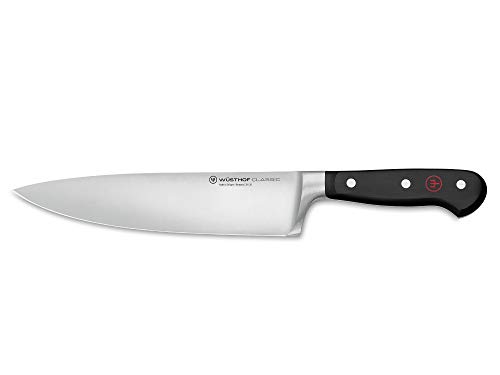
The Wusthof
The Zwilling

Zwilling has the edge on 3 of 10 lines, Wusthof on 1, 3 even.
| Feature | Wusthof | Zwilling |
|---|---|---|
| ConstructionEven | Forged from one block of steel, full bolster | Forged from one piece of steel (Sigmaforge), bolster |
| Hardness | 58 HRC (the edge) | 57 HRC |
| Edge angle | 14 degrees per side | 15 degrees per side |
| Weight | 8.5 oz (listing figure) | About 6.7 oz (0.42 lb, maker's figure) |
| Handle | Synthetic, triple riveted, full tang | Seamless polypropylene, at least 75% recycled plastic |
| Dishwasher | Hand wash | Dishwasher safe, hand washing recommended (the edge) |
| Made inEven | Solingen, Germany | Solingen, Germany |
| WarrantyEven | Limited lifetime | Lifetime |
| In the box | 8 in chef's knife | 8 in chef's knife and 4 in paring knife (the edge) |
| Price | About $170 | About $115 to $170 for the pair (the edge) |
The verdict
Buy the Wusthof Classic if you like a heavier knife with a riveted handle and a slightly keener edge. Buy the Zwilling Four Star if you want a lighter knife, a smooth handle and a paring knife in the same box for less money.
The chef's knife worth buying once.The chef's knife for under $100.The knife set for home cooks.
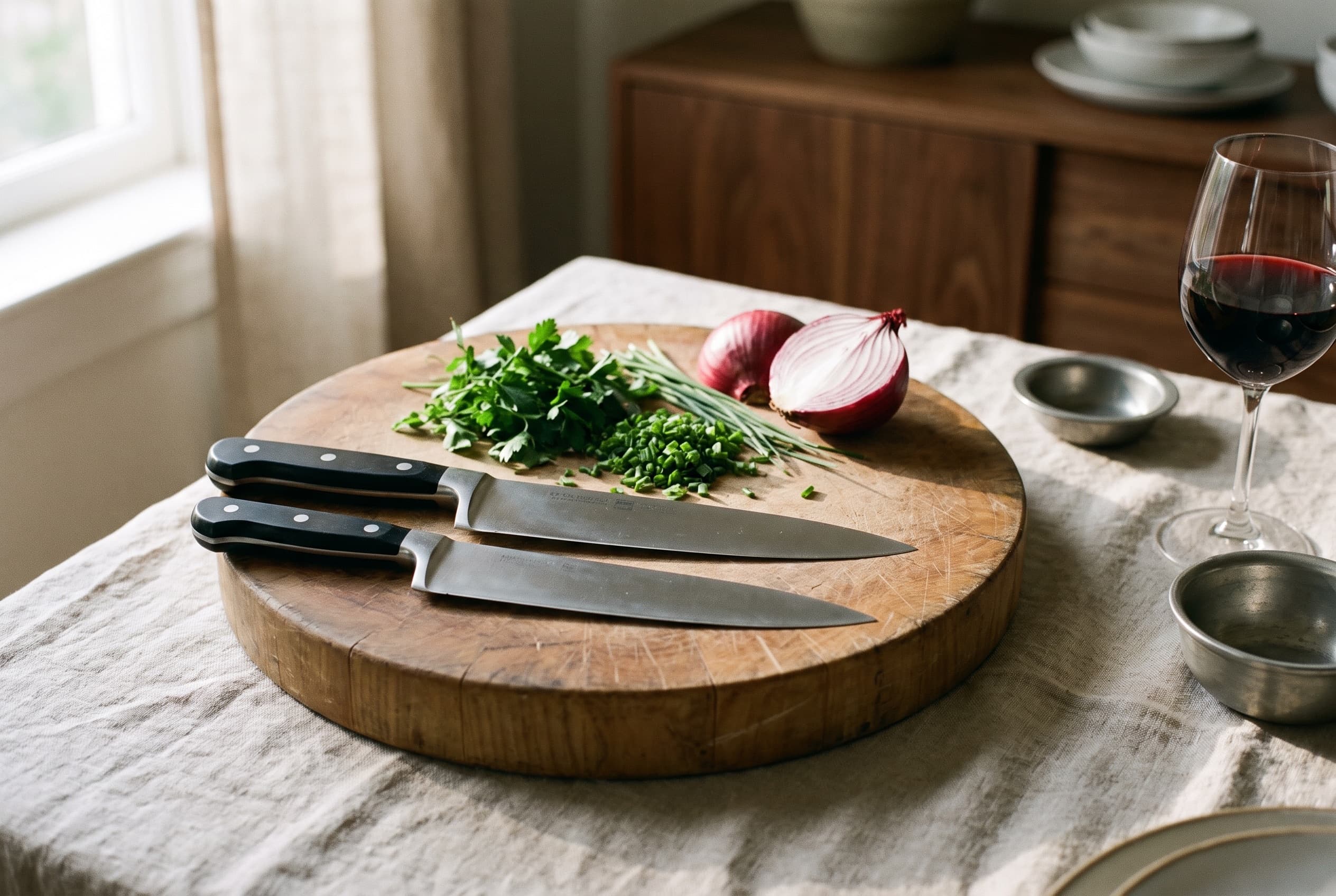
Wusthof and Zwilling are both in Solingen, both forge their knives from a single piece of stainless steel, and both have been at it for about two centuries or more. Wusthof dates to 1814. Zwilling dates to 1731. Most of what separates their best-known chef's knives is a matter of feel rather than quality.
The two knives compared here are each maker's standard: the Wusthof Classic 8 inch, with its riveted handle and full bolster, and the Zwilling Four Star 8 inch, the line Zwilling calls its bestselling series, with a smooth one-piece plastic handle. On Amazon the Four Star chef's knife is easiest to find paired with a 4 inch paring knife, and the pair usually costs less than the Wusthof alone.
Hold both if you can. If you cannot, the numbers below will get you most of the way: the Wusthof is heavier and a touch harder, the Zwilling lighter and more forgiving about the dishwasher.
The heavier, slightly harder of the two, with a riveted handle and a full bolster.
The Classic is Wusthof's best-selling line. The 8 inch chef's knife is forged from a single block of high-carbon stainless steel, tempered to 58 HRC and given a 14 degree edge per side by Wusthof's Precision Edge Technology. The handle is a durable synthetic, fixed with three rivets over a full tang, and the listing gives the weight as 8.5 ounces.
That weight is the thing you notice. It falls through an onion with little effort and feels planted on a board. Cooks who like a light knife find it tiring. The full bolster runs down to the heel of the blade, which protects fingers but means the bolster has to be ground back over many years of sharpening.
Wusthof asks you to wash it by hand and backs it with a limited lifetime warranty. It does not sharpen by mail itself; its site points owners to a third-party service. Skip it if you want the knife to live in the dishwasher.
The catch. Heavier than the Zwilling, and the full bolster complicates sharpening over the long run.
Where to buy
AmazonCheck price →A lighter forged chef's knife with a smooth handle, sold with a paring knife for less than the Wusthof alone.
Four Star is the line Zwilling calls its top-selling knife series worldwide, and it has been on sale for about fifty years. The knives are forged from one piece of Zwilling's special formula high-carbon stainless steel, ice-hardened by its Friodur process to 57 HRC, with a 15 degree edge per side. The set pairs the 8 inch chef's knife with a 4 inch paring knife.
The handle is the difference you feel. It is a single molded piece of polypropylene, now made with at least 75 percent recycled plastic, with no rivets and no seams. Zwilling gives the chef's knife a net weight of 0.42 pounds, about 6.7 ounces, so it is noticeably lighter in the hand than the Wusthof.
Zwilling rates it dishwasher safe, though it recommends hand washing, and covers it with a lifetime warranty. Zwilling also sells a mail-in sharpening service. Skip it if you prefer the look and grip of a riveted handle.
The catch. The plain plastic handle looks utilitarian next to a riveted one, and some hands find it slick when wet.
Where to buy
AmazonCheck price →Wusthof's stamped chef's knife, for those who want the name and a lighter blade at a lower price.
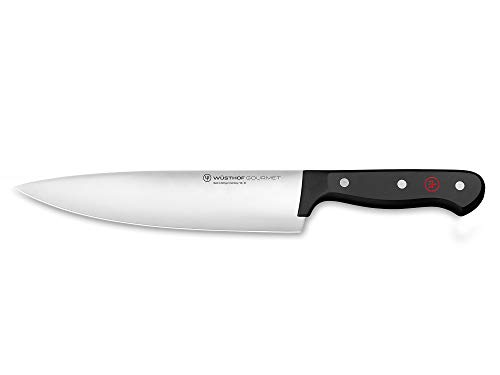
Gourmet knives are laser cut from sheet steel rather than forged, with polypropylene handles. They carry the Solingen name and the same limited lifetime warranty as the Classic.
Stamping leaves a thinner, lighter blade with no bolster, which some cooks prefer and which makes sharpening simpler. It is a sensible second knife, or a first one for a cook who is not sure about spending $170.
Skip it if you want the heft and balance of a forged knife. That is what the extra $70 for the Classic buys.
The catch. A stamped knife feels lighter and less substantial than the forged Classic.
Where to buy
AmazonCheck price →A stamped Swiss knife that cuts far better than its price and handle suggest.

The Fibrox is stamped from sheet steel with a non-slip thermoplastic handle, and it is a common sight in restaurant kitchens. The blade is 7.9 inches and the maker calls it dishwasher safe.
It is here as a check on the German pair. If you are unsure you will hone and sharpen a knife, spend $45 on this first and buy forged later.
It will not impress anyone at the counter, and softer steel dulls faster. Victorinox covers it against defects for life.
The catch. Plain looks and softer steel that needs sharpening more often.
Where to buy
AmazonCheck price →On paper, one degree of hardness and one degree of edge angle. Neither is enough for most cooks to notice in use. Weight and handle are what people notice: the Wusthof is about a quarter heavier, and its riveted handle is squarer in the hand than the Zwilling's rounded one.
Both makers also sell other lines. Zwilling Pro has a sloped bolster that stops short of the heel. Wusthof Classic Ikon has a half bolster and a contoured handle. Compare like with like when you shop.
Hone every few uses on a steel, and sharpen when the knife starts to skate on a tomato skin. Both knives take a Western edge and sharpen easily on a whetstone or a good pull-through for German steel.
Dishwasher safe is not the same as dishwasher friendly. Heat, detergent and rattling against other things dull any edge. Wash by hand and dry at once.
Neither, in any way that matters to most cooks. Both forge their knives in Solingen from stainless steel at 57 to 58 HRC. The Wusthof Classic is heavier with a riveted handle; the Zwilling Four Star is lighter with a molded one.
Four Star is Zwilling's best seller and the usual counterpart. Pro is closer in look, with a riveted handle, and has a sloped bolster that makes sharpening easier.
Zwilling calls the Four Star dishwasher safe but recommends hand washing. Wusthof asks for hand washing. Either way, hand washing keeps the edge longer.
Both are made in Solingen, Germany, according to their makers.
The Four Star uses a molded plastic handle rather than a riveted one and is often discounted on Amazon. Zwilling's own list price for the pair is close to the Wusthof's.
 KitchenHexClad vs Henckels Paradigm: Which Hybrid Pan to Buy
 KitchenLe Creuset vs Caraway Dutch Oven: Which to Buy
 KitchenBest Revolving Cake Stand for Decorating
 KitchenBest Cast Iron Skillet for a Glass Top Stove
 KitchenBest Chef's Knife Under $100: Five Worth Buying
 KitchenBest Cutting Board for Raw Meat and Poultry
 KitchenBest Cutting Board: End Grain vs Edge Grain Wood
 KitchenThe Best Meat Thermometers: Instant-Read and Leave-In
The Bonwits Letter
What is worth buying for the house this week, what is actually on sale, and what to skip. Short, and never sponsored.