Bonwits

The chef's knife worth buying once.

One good chef's knife does nine tenths of the cutting in a house. The choice comes down to steel, edge and whether you will keep it sharp.

By the Bonwits editors
Updated September 25, 2026
5 picks
The chef's knife worth buying once

At a glance.

No.The pickForPriceBuy
01Wusthof Classic 8" Chef's KnifeThe one to buyAbout $170Check price →
02ZWILLING Pro 8-inch Chef's KnifeThe German alternativeAbout $170Check price →
03Shun Classic 8" Chef's KnifeJapanese steel, with a safety netAbout $190 to $240Check price →
04Tojiro FU-889 Chef's Knife, 210 mm, Cobalt Alloy SteelThe Japanese value pickAbout $85Check price →
05Victorinox Fibrox Chef's Knife 8 inchThe honest entry pointAbout $45 to $70Check price →

Before you buy.

A knife block of fourteen pieces is mostly a way to sell a paring knife you will not use. The chef's knife is the one that matters: eight inches or 210 millimeters, used every day, and the tool guests notice when they offer to help chop.

There are two schools. German knives from Solingen are thicker, softer and forgiving. They take a knock against a bone or a careless drawer and come back with a few strokes on a hone. Japanese knives are thinner, harder and sharper out of the box, and they hold that edge longer, but hard steel chips where soft steel rolls. Neither is better. They suit different cooks.

Whichever you choose, the edge is what you are paying for, and every edge dulls. Before you buy, know who will sharpen it. Several makers here run their own service, and it is a better reason to choose a brand than most of what is printed on the box.

Steel and hardness
Measured on the Rockwell C scale. Around 56 to 58 is German and tough. Around 60 and up is Japanese, holds an edge longer and needs gentler handling.
Edge angle
Degrees per side. Lower is sharper and more fragile. The knives here run from about 14 to 16 degrees per side, plus one asymmetric Japanese grind.
Sharpening support
Whether the maker sharpens its own knives by mail, what it costs, and who qualifies. This decides whether a knife stays good for decades.
Warranty and origin
Where it is forged or finished, and what the maker will stand behind.
No. 01The one to buy

Wusthof

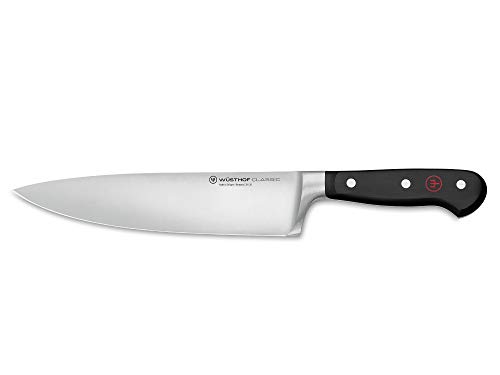
Wusthof Classic 8" Chef's Knife

The German standard: a full bolster, a durable edge, and nothing about it that will surprise you.
Wusthof Classic 8" Chef's Knife
Price
About $170 (Amazon today: $170.00)
Made in
Germany (Solingen)
Keeps for
Decades, with honing and a sharpening every year or two
Steel
Forged German stainless
Hardness
58 HRC
Edge angle
14 degrees per side
Blade
8 in
Care
Hand wash
Warranty
Limited lifetime

Wusthof has been making knives in Solingen since 1814, and the Classic is its core line. The blade is forged from German stainless steel hardened to 58 HRC and sharpened by machine to 14 degrees per side, which is keener than older German knives used to leave the factory.

It is a knife that tolerates a household. It can go through a chicken joint, survive a hurried hand wash and come back with a few passes on a honing steel. The full bolster adds weight and balance, and it protects your fingers.

The same bolster is the downside. It runs to the heel of the blade, so over years of sharpening it has to be ground back or the edge develops a gap near the handle. Wusthof does not sharpen by mail itself and lists a third party, Eversharp in Minneapolis, on its site for that work. Skip it if you prefer a thin, light blade.

The catch. The full bolster complicates sharpening over the long run.

No. 02The German alternative

Zwilling

ZWILLING Pro 8-inch Chef's Knife

Solingen steel with a sloped bolster that makes it easier to sharpen and nicer in a pinch grip.

ZWILLING Pro 8-inch Chef's Knife
Price
About $170 (Amazon today: $149.99)
Made in
Germany
Keeps for
Decades, with regular honing and sharpening
Steel
Special formula high-carbon stainless, Friodur ice-hardened
Hardness
55 to 58 HRC
Blade
About 7.9 in
Weight
About 0.58 lb
Dishwasher
Safe, hand washing recommended
Warranty
Lifetime

Zwilling Pro is forged in Germany from a single piece of Zwilling's special formula stainless steel and ice-hardened by the company's Friodur process. Zwilling rates the blade at 55 to 58 HRC, in the same family as the Wusthof.

The difference is the bolster. On the Pro it is curved and sloped back, so it supports a pinch grip on the blade and stops short of the heel. That leaves the whole edge free to sharpen for the life of the knife. It weighs about 0.58 pounds.

Zwilling also sells its own mail-in sharpening through Knife Aid, sold on its site by the number of knives, with a prepaid insured envelope. Skip it if you want the hardest steel for the price, which is the Japanese knives' territory.

The catch. Slightly softer steel than the Wusthof on paper, so it may need honing more often.

No. 03Japanese steel, with a safety net

Shun

Shun Classic 8" Chef's Knife

A hard, thin Japanese blade backed by the best maker-run sharpening program in the category.

Shun Classic 8" Chef's Knife
Price
About $190 to $240 (Amazon today: $140.14)
Made in
Japan (Seki City)
Keeps for
Decades, sharpened by the maker
Steel
VG-MAX core, 34 layers Damascus cladding each side
Edge angle
16 degrees per side
Weight
About 6.7 oz
Handle
Pakkawood, D-shaped
Sharpening
Free for original owners, $15 US return fee
Warranty
Limited lifetime

Shun is made by Kai in Seki City, Japan. The Classic has a VG-MAX steel core clad in 34 layers of Damascus on each side, with a 16 degree edge per side and a D-shaped Pakkawood handle. It weighs about 6.7 ounces, lighter than the German knives.

The reason to buy it is Kai's sharpening service. Original owners who bought from authorized dealers in the US, Canada or Mexico can send Shun knives to Kai's facility in Tualatin, Oregon to be sharpened free, paying a $15 return shipping and processing fee in the US. Kai estimates two weeks turnaround. That turns a hard, fussy blade into one that can stay sharp for decades without the owner learning to use a whetstone.

The steel is harder and more brittle than German steel. Owners report small chips from bones, frozen food and glass or stone boards. Skip it if the knife will be used by everyone in the house, including the person who puts it in the dishwasher.

The catch. Harder steel chips more readily than German knives. Not for bones or the dishwasher.

No. 04The Japanese value pick

Tojiro

Tojiro FU-889 Chef's Knife, 210 mm, Cobalt Alloy Steel

A real Japanese gyuto for half the price of the famous names: hard cobalt steel core, stainless cladding, all-steel handle.

Tojiro FU-889 Chef's Knife, 210 mm, Cobalt Alloy Steel
Price
About $85 (Amazon today: $83.75)
Made in
Japan
Keeps for
Decades, with a whetstone or a sharpening service
Blade
210 mm (8.3 in) gyuto, double bevel
Core
Cobalt alloy steel
Cladding
13 chrome stainless steel
Handle
18-8 stainless steel
Care
Hand wash recommended

Tojiro is a knife maker in Tsubame, Niigata, and its Fujitora line is its most widely distributed. This 210 millimeter gyuto has a core of cobalt alloy steel clad in 13 chrome stainless, which gives a hard, keen edge on the inside and easy care on the outside. The handle is 18-8 stainless steel, so there is no wood to crack or rot.

A gyuto is the Japanese version of the chef's knife: thinner and lighter than a German blade, with a flatter profile made for push cuts rather than rocking. At 210 millimeters, about 8.3 inches, it is the size most home cooks settle on.

Skip it if you want a knife you can neglect. Thin, hard Japanese edges chip if you twist them through squash or bone, and they want a whetstone or a sharpening service rather than a pull-through sharpener. Hand wash it, whatever the box says.

The catch. Harder and thinner than a German knife, so it chips if misused, and the all-steel handle is slick when wet.

No. 05The honest entry point

Victorinox

Victorinox Fibrox Chef's Knife 8 inch

A stamped Swiss knife that cuts far better than its price and handle suggest.

Victorinox Fibrox Chef's Knife 8 inch
Price
About $45 to $70 (Amazon today: $45.50)
Made in
Switzerland
Keeps for
Years to decades; cheap enough to replace
Construction
Stamped, not forged
Blade
7.9 in
Weight
About 6.4 oz
Handle
Thermoplastic elastomer
Dishwasher
Safe
Warranty
Lifetime

The Fibrox is stamped from sheet steel rather than forged, has a plastic non-slip handle, and is made in Switzerland. It is a common sight in restaurant kitchens, and it is dishwasher safe, which no other knife here claims without a caveat.

It is light at about 6.4 ounces, thin enough to cut well, and soft enough to sharpen easily on anything. Victorinox covers it with a lifetime warranty.

It will not impress anyone at the counter. Buy it if you are not sure you will keep a knife sharp, or as the knife you hand to guests while yours stays in the drawer.

The catch. Softer steel dulls faster, and the plastic handle looks like what it is.

Western or Japanese edge

German knives are ground symmetrically and hardened to about 56 to 58 HRC. They are thicker, roll rather than chip, and come back with a honing steel. Japanese knives run harder, often 60 HRC or more, and thinner. They cut with less force and stay sharp longer, but they chip on bones and frozen food and should not be honed on a grooved steel.

If you cook quickly and not always carefully, buy German. If you cook deliberately and will look after an edge, buy Japanese.

Keeping it sharp

Hone German knives every few uses. Sharpen any knife when it starts to slide off a tomato skin. The maker programs are the easiest path: Shun sharpens free for original owners with a $15 US return fee, and Zwilling sells Knife Aid envelopes. Wusthof points owners to Eversharp in Minneapolis.

Never put a good knife in the dishwasher, and never store it loose in a drawer. A magnetic strip or an in-drawer block is cheaper than a regrind.

What to skip

Large block sets, where the chef's knife subsidizes six knives you will not use. Glass and stone cutting boards. Pull-through sharpeners on Japanese knives, which remove a lot of metal and can chip hard steel.

Questions.

Is a Japanese knife better than a German one?

Sharper and lighter, usually. Not better for everyone. Harder Japanese steel holds an edge longer but chips more easily. German knives are tougher and easier to maintain.

What length chef's knife should I buy?

Eight inches, or 210 millimeters for Japanese knives. It suits most hands and most boards. Go to 10 inches only if you have a large board and like long strokes.

Does Shun really sharpen knives for free?

Yes, for original owners who bought from authorized dealers in the US, Canada or Mexico. You pay shipping to Kai in Tualatin, Oregon, plus a $15 return and processing fee in the US.

Can a chef's knife go in the dishwasher?

Victorinox says the Fibrox can, and Zwilling says the Pro can with hand washing recommended. For any knife you care about, hand wash and dry it right away.

What does HRC mean?

Rockwell hardness, C scale. Higher numbers hold an edge longer and are harder to sharpen and more prone to chipping. Most German knives sit around 56 to 58, most Japanese around 60 and up.

Sources.

  1. Wusthof, Classic 8" Chef's Knife
  2. Zwilling, Pro 8-inch Chef's Knife
  3. Shun, sharpening service
  4. Tojiro, company site

More from Kitchen.

01The Dutch oven to hand down.02The roasting pan for the holidays.