The Riedel

One is the glass that invented the varietal-specific category. The other is an Italian glassmaker's answer: lead-free crystal with a titanium-treated stem and a 25 year guarantee, at well under half the price.
Tap either one to check today’s price.
The Riedel
The Luigi Bormioli

Luigi Bormioli has the edge on 3 of 10 lines, Riedel on 0, 2 even.
| Feature | Riedel | Luigi Bormioli |
|---|---|---|
| Price on Amazon | About $85 for two | About $32 for two (the edge) |
| Material | Crystal glass without lead oxide as a principal ingredient (Riedel's definition) | SON.hyx lead-free crystal glass |
| Made | Machine-made; Vinum introduced 1986 | Machine-blown, pulled stem with titanium treatment, laser cut rim |
| Made in | Not stated on the listing | Italy (the edge) |
| Capacity | Not stated on the listing | 18.5 oz |
| Height | 8.9 in | Not stated on the listing |
| Shape | Tall tapered Cabernet/Merlot bowl, varietal specific | Convex Bordeaux bowl with an indentation in the base |
| DishwasherEven | Yes; Riedel says most glasses take at least 1,000 cycles | Yes; maker claims clarity after 4,000 industrial cycles |
| Warranty | None stated | 25 year limited guarantee against rim or foot chipping and wash clouding (the edge) |
| Seller on AmazonEven | Amazon.com | Amazon.com |
The verdict
Buy the Riedel if you want the reference Cabernet shape and the name on the box, and will pay about $85 for two. Buy the Luigi Bormioli if you want a lead-free Bordeaux glass with a reinforced stem and a 25 year guarantee for about $32 a pair, and do not mind that it is not the famous one.
The glass for white wine.The crystal that leaves the lead out.The red wine glass, Bordeaux or Burgundy.
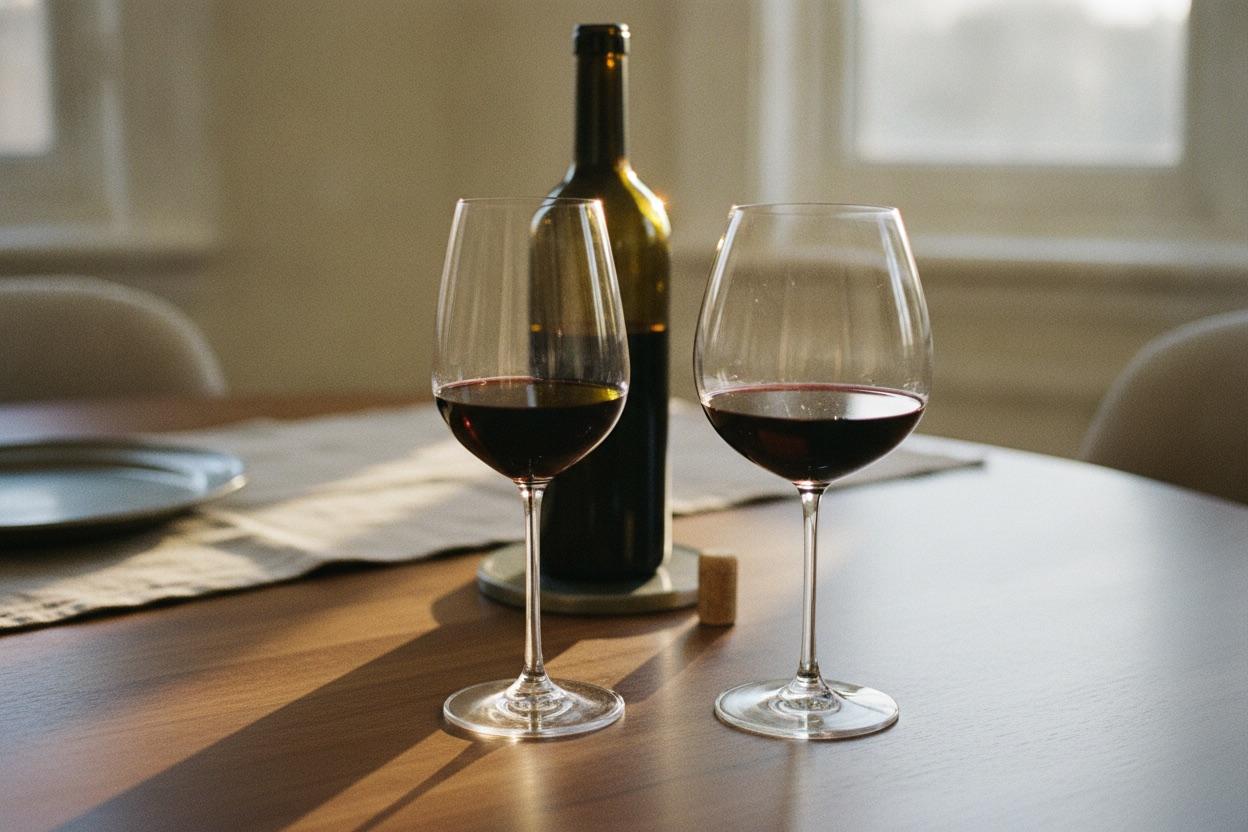
Riedel's Vinum is the glass most people picture when they hear the brand. Georg Riedel designed it in 1986 as the first machine-made collection shaped for specific grapes, scaled down from the handmade Sommeliers series of 1973, and the Cabernet Sauvignon/Merlot glass is its flagship: a tall, tapered bowl that directs a full bodied red to the right part of the palate, according to Riedel. Since 2015 the company has made only crystal glass, which it defines as glass that does not use lead oxide as a principal ingredient, and every Vinum glass is dishwasher safe.
Luigi Bormioli, of Parma, comes at the same glass from the engineering side. Its SON.hyx material is a lead-free crystal glass the company describes as resisting more than 4,000 industrial dishwasher cycles without clouding, and its stemware gets a permanent titanium treatment on the pulled stem to resist breakage. The company backs SON.hyx stemware with a 25 year limited guarantee against chipping on the rim or foot and against clouding from washing. The Supremo Bordeaux is its Cabernet glass: an 18.5 ounce convex bowl with a laser cut rim and an indentation in the base of the bowl that Luigi Bormioli says shows the wine's color.
Both sets here are sold on Amazon by Amazon.com itself, two glasses to a box. Luigi Bormioli's Atelier line, the one most often compared with Vinum, is only sold on Amazon by third parties, so the Supremo stands in; it is the same SON.hyx glass in a plainer shape. Three alternatives follow: Zwiesel Glas Pure for a German Cabernet glass sold in fours, Spiegelau Definition for a lighter German Bordeaux glass, and Gabriel-Glas StandArt for anyone who wants one glass for every wine.
The original machine-made varietal glass, designed in 1986 and still the Cabernet shape the rest of the industry measures against.
Vinum was the first collection to bring Riedel's grape specific shapes to a machine-made glass, which cut the price and made the idea mainstream. The Cabernet Sauvignon/Merlot glass is the one most people own: 225 millimeters tall, 95 millimeters across, with a large tapered bowl and a thin, finely drawn stem. Riedel's recommended pour is 125 milliliters, about four ounces, which leaves the bowl mostly empty for the aroma to collect. It is dishwasher safe, and Riedel's FAQ says most of its glasses survive at least 1,000 cycles without losing shine when loaded properly.
The material is what Riedel now calls crystal glass: since 2015 the company has produced only glass that does not use lead oxide as a principal ingredient, so Vinum is not leaded crystal despite the brilliance. The Amazon listing does not say where the glass is made, and Riedel does not say on its Vinum page either.
Skip it if you break things. The bowl is thin by design and the price per glass is more than two and a half times the Luigi Bormioli's. Skip it too if you drink across many grapes and want one glass; the Gabriel-Glas below is the better answer.
The catch. About $42 a glass, no stated warranty, and an origin the listing does not give.
Where to buy
AmazonCheck price →Lead-free SON.hyx crystal glass with a titanium-treated stem, made in Italy and guaranteed for 25 years, at about $16 a glass.
Luigi Bormioli makes the Supremo in SON.hyx, its own lead-free crystal glass. The company's warranty sheet describes it as ultra clear, highly resistant to breakage, and able to keep its sparkle through more than 4,000 industrial dishwasher cycles. The stem is pulled rather than molded, so it has no seam, and it carries a permanent titanium anti-abrasion treatment that the maker says raises its resistance to breakage. The rim is laser cut and the foot is flat.
The Bordeaux shape holds 18.5 ounces in a convex bowl that the maker says favors Bordeaux, Merlot and Cabernet after ten minutes in the glass, and the base of the bowl has an indentation, which Luigi Bormioli calls the Epicure base, that catches light and shows the wine's color. The glasses are made in Italy and sold on Amazon by Amazon.com.
The 25 year limited guarantee is the clincher. It covers chipping on the rim or foot and any cloudiness or discoloration from washing, and the maker replaces the glass at no charge; you pay to send the damaged one back, and breakage from misuse is excluded. Skip it only if you want the Riedel's exact shape or the name. This is not Atelier, Luigi Bormioli's thinner top line, which Amazon sells only through third parties.
The catch. A plainer, slightly heavier shape than Riedel's Vinum or Luigi Bormioli's own Atelier.
Where to buy
AmazonCheck price →Four German Cabernet glasses in Tritan crystal glass for less than two Riedels, with the angular Pure shape.

Zwiesel Glas, formerly sold in the United States as Schott Zwiesel, makes Pure in Tritan, a titanium and zirconium reinforced crystal glass that is the standard in restaurants that run glasses through a machine every night. The Pure Cabernet holds about 19 ounces, stands 9.6 inches, and comes four to a box for about $50, sold by Amazon.com. It is made in Germany.
The shape is the distinctive thing. Pure has a squared off bowl that steps in at the shoulder, more architectural than Riedel's smooth taper. It gives Cabernet the room it needs and looks deliberate on a table. Owners report years of dishwasher use without clouding or chips.
Skip it if you want the classic tulip profile; Pure's angles are a style decision you either like or do not. Skip it if you want two glasses rather than four.
The catch. The angular bowl is not for everyone, and the set comes only in fours.
Where to buy
AmazonCheck price →Spiegelau's top machine-made Bordeaux glass: very light, lead-free crystal, made in Germany, sold through the brand's US distributor.

Spiegelau says it has more than five centuries of glassmaking behind it, and Definition is its top machine-made series. The Definition Bordeaux is a tall, wide bowled Cabernet glass in lead-free crystal, made in Germany, dishwasher safe, and strikingly light in the hand for a machine-made glass. Spiegelau says the series is engineered for sensory performance and built to be durable and well balanced.
On Amazon the glasses are sold by True Brands, which Spiegelau names as its US distributor; that qualifies under our rule that a pick must be sold by the brand or its official distributor. At about $70 for two it sits between the Luigi Bormioli and the Riedel.
Skip it if you want a warranty; none is stated. Skip it if you want a heavier, more forgiving glass, which is what the Zwiesel is for.
The catch. No stated warranty, and the listing does not give capacity or height.
Where to buy
AmazonCheck price →The Austrian universal glass: machine-made lead-free crystal that handles Cabernet, Pinot and Chardonnay well enough that many restaurants stock nothing else.

Gabriel-Glas makes one shape. The StandArt is the machine-made edition, Austrian crystal, lead-free, about 16 ounces, with a broad bowl that narrows to a rim sized for reds and whites alike. It is sold on Amazon by Gabriel-Glas North America, the brand's own US arm, in a two glass gift box for about $68.
The argument for it is the cupboard. If the Riedel and Luigi Bormioli question is really about owning a proper Cabernet glass, Gabriel-Glas asks whether you need a Cabernet glass at all. Sommeliers and wineries use it, the company says, because one durable glass for all wines makes service simpler, and owners report it shows reds as well as most varietal glasses.
Skip it if you like the ritual of a tall Bordeaux bowl, or if you want more than 16 ounces. For a household that drinks a bit of everything and owns one set of good glasses, it is the one to buy.
The catch. Smaller than a dedicated Cabernet bowl, and the universal shape gives up a little for big reds.
Where to buy
AmazonCheck price →Traditional lead crystal is glass with lead oxide added, historically 24 percent or more, which raises the refractive index and gives the brilliance and ring the word crystal implies. It is also softer and heavier, and acidic drinks stored in it can leach lead. Most stemware makers have moved to lead-free formulas that substitute other oxides for the sparkle: Riedel's crystal glass, made exclusively since 2015, Luigi Bormioli's SON.hyx, Zwiesel's Tritan. These are harder, lighter and dishwasher friendly, and in the United States the word crystal on a box no longer tells you lead is present. If it matters to you, read for the phrase lead-free.
Most wine glasses die at the stem, snapped in the dishwasher rack or in the sink. A pulled stem, drawn from the same gather of glass as the bowl, has no seam and is stronger than a molded stem joined on afterward; Luigi Bormioli adds a titanium surface treatment on top of that. Riedel's Vinum stem is fine and the bowl is thin, which is part of its elegance and part of its mortality. Whatever you buy, a stemware rack in the dishwasher, no glass to glass contact, and a soft, low mineral water will add years.
Luigi Bormioli's Atelier Cabernet/Merlot, at 23.75 ounces, is the glass most often set against Vinum in the trade, in the same SON.hyx glass with the same titanium stem and 25 year guarantee. On Amazon it is sold only by third party sellers, which is why the Supremo stands in here. If you see Atelier sold directly by the brand or Amazon.com, it is the closer match to the Riedel.
In material and durability, yes or better: lead-free SON.hyx crystal glass with a titanium-treated stem and a 25 year guarantee, at less than half the price. In shape and reputation, Riedel's Vinum is still the reference Cabernet glass.
Not any more. Riedel says that since 2015 it has produced only crystal glass, which it defines as glass that does not use lead oxide as a principal ingredient.
Luigi Bormioli's name for its lead-free crystal glass. The maker describes it as ultra clear, break resistant, and able to keep its clarity through more than 4,000 industrial dishwasher cycles.
Chipping on the rim or foot, and cloudiness or discoloration from washing, on SON.hyx stemware. The maker replaces the glass; the customer pays return shipping. Breakage and damage from misuse are not covered.
Yes. Riedel says all Vinum glasses are dishwasher safe and most of its glasses survive at least 1,000 cycles when loaded properly, ideally in a stemware rack.
The Amazon listing does not say, and Riedel's Vinum page does not either. Riedel is an Austrian company with its own factories; the Luigi Bormioli listing states Italy.
 GlassThe Best White Wine Glass: Riesling, Chardonnay, Universal
 GlassIs Riedel Worth It? Why the Glasses Cost What They Do
 GlassRiedel vs Spiegelau: Same Owner, Different Glasses
 GlassBest Everyday Drinking Glasses for Water and Juice
 GlassChampagne Flute vs Coupe (Saucer): Which to Buy
 GlassRiedel vs Schott Zwiesel: Everyday Wine Glasses Compared
 GlassLead-Free Crystal Wine Glasses and Decanters
 GlassBest Red Wine Glasses: Bordeaux and Burgundy Shapes
The Bonwits Letter
What is worth buying for the house this week, what is actually on sale, and what to skip. Short, and never sponsored.

