Bonwits

The nonstick pan worth buying, knowing it will wear out.

Every nonstick pan is a consumable. The only questions are how long it stays slick, what it costs per year, and whether the pan underneath deserves the coating.

By the Bonwits editors
Updated September 27, 2026
5 picks
Save to Pinterest
The nonstick pan worth buying, knowing it will wear out

The short list.

5 picks. Tap any to check today’s price.

  1. The one to buyOur pick
    Tramontina Professional 10-Inch Non Stick Frying Pan

    No. 01Tramontina

    Tramontina Professional 10-Inch Non Stick Frying Pan

    $35 on Amazon today

  2. For an induction cooktop
    All-Clad HA1 Expert Nonstick, 10" Fry Pan, Induction Ready
  3. The ceramic choice
    GreenPan Valencia Pro Hard Anodized Healthy Ceramic Nonstick 10" Frying Pan Skillet
  4. The one built to take metal
    Scanpan Professional Nonstick Fry Pan 10.25"

    No. 04Scanpan

    Scanpan Professional Nonstick Fry Pan 10.25"

    $110 on Amazon today

  5. If money is no object
    All-Clad D3 Pro Nonstick Stainless Steel 12" Fry Pan, Made in the USA

Before you buy

Read this first.

Picks
5
Price range
$35 to $180
Updated
September 27, 2026

Start with the fact the packaging leaves out. A nonstick coating is a thin layer on top of the metal, and heat, scrubbing and time wear it away. America's Test Kitchen says plainly that nonstick skillets have to be replaced fairly frequently. A cast iron or stainless pan can outlive its owner; a nonstick pan will not, whatever it costs.

That changes how to shop. The sensible nonstick pan is one that does eggs, fish and crepes perfectly for as long as the coating holds, and costs little enough that replacing it is not a grievance. Spending more buys a better pan under the coating, a sturdier coating or induction compatibility. It does not buy a coating that lasts forever.

There are two kinds of coating. PTFE, the material most people call Teflon, is the slicker and longer lasting. Ceramic, a sol-gel coating made without PTFE or other PFAS, appeals to cooks who would rather avoid fluoropolymers, but independent testing finds it loses its slickness sooner. Both are here, with the trade stated plainly.

What we judged on.

4 tests, applied to every pick below

  1. 01

    Release, then durability

    How cleanly eggs slide at the start, and how long independent testers found the surface stayed that way.

  2. 02

    The pan under the coating

    Heavy aluminum or clad stainless that heats evenly and stays flat. A thin pan warps and wears its coating unevenly.

  3. 03

    Cost per year

    Price weighed against a realistic life. A $35 pan that lasts three years costs less per year than a $180 pan that lasts five.

  4. 04

    Heat and cooktop limits

    Oven rating and induction compatibility as the maker states them, since both vary widely in this category.

No. 01The one to buy

Tramontina

Tramontina Professional 10-Inch Non Stick Frying Pan

A restaurant pan with a slick PTFE coating, cheap enough to replace without a second thought.

Tramontina Professional 10-Inch Non Stick Frying Pan
Price
About $35 (Amazon today: $34.95)
Made in
Brazil
Keeps for
A few years of daily eggs; replace when food starts to catch
Body
Heavy-gauge aluminum
Coating
Reinforced PTFE nonstick
Oven
Safe to 400°F, with the silicone sleeve removed
Cooktops
Gas, electric, ceramic glass; not induction
Care
Dishwasher safe; NSF certified
Warranty
Lifetime

This is Tramontina's restaurant line, and for home cooks it answers the nonstick problem best: heavy-gauge aluminum for even heat, a reinforced PTFE coating, a cast stainless handle with a removable silicone sleeve, all for about the price of a good dinner out. It is made in Brazil and NSF certified, which means it was built for commercial kitchens.

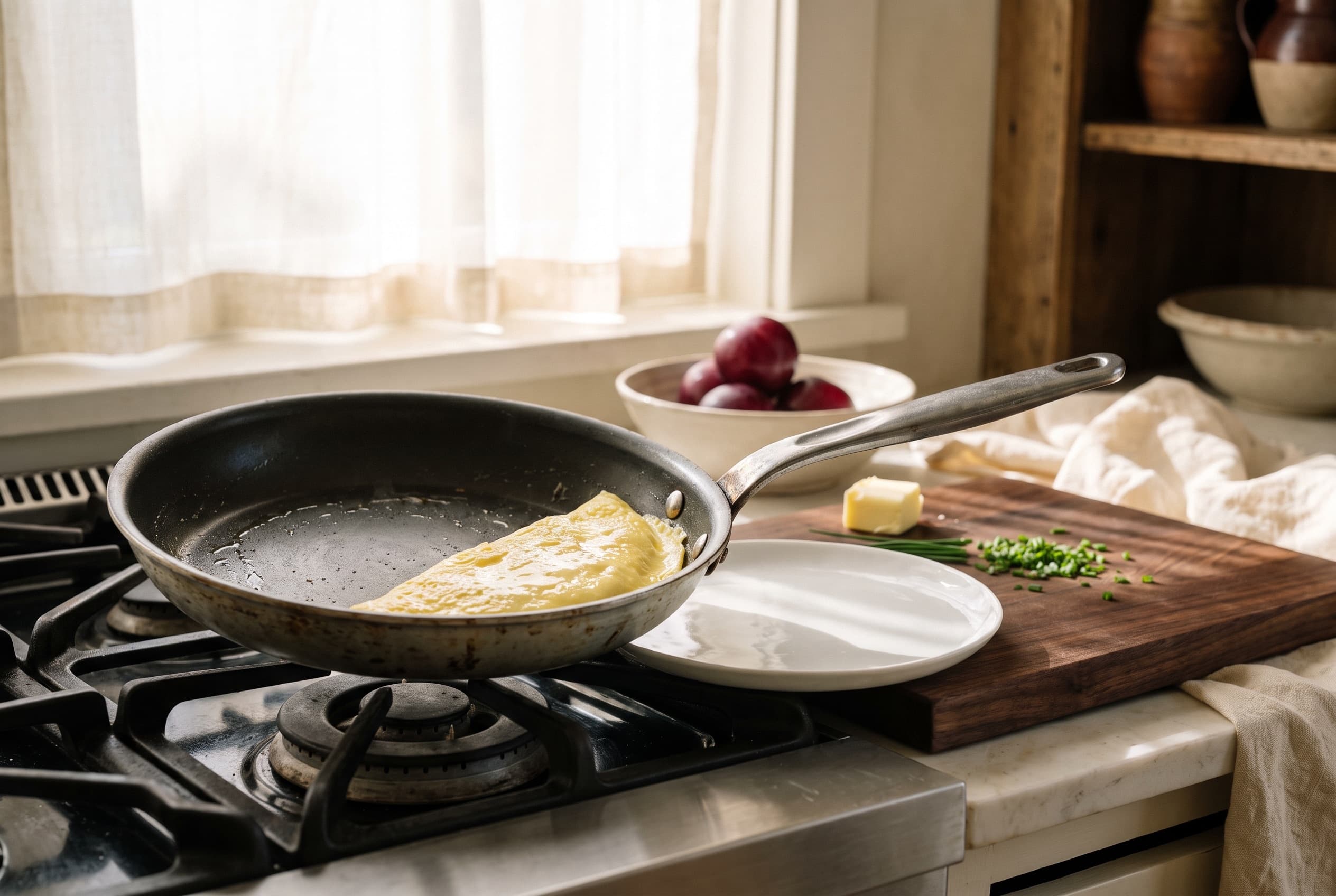
Wirecutter has long named it the top nonstick pick. The appeal is simple. The flared sides let an omelet slide straight onto a plate, the pan is light enough to toss with one hand, and when the coating eventually tires, a new one costs less than most people spend on a single fancy pan's lid.

Skip it if you cook on induction; the plain aluminum base will not work. Tramontina says it is dishwasher safe, but hand washing will keep the coating slick for longer.

The catch. No induction, and the lifetime warranty does not make the coating last a lifetime.

No. 02For an induction cooktop

All-Clad

All-Clad HA1 Expert Nonstick, 10" Fry Pan, Induction Ready

Hard-anodized aluminum with a steel plate underneath, so the same easy nonstick works on induction.

All-Clad HA1 Expert Nonstick, 10" Fry Pan, Induction Ready
Price
About $80 (Amazon today: $79.95)
Made in
China (designed in Pennsylvania)
Keeps for
A few years of regular use
Body
Hard-anodized aluminum, stainless steel base
Coating
PTFE nonstick
Oven
Safe to 500°F
Cooktops
All, including induction
Care
Dishwasher safe; maker suggests hand washing to preserve the coating
Warranty
Limited lifetime

HA1 Expert is All-Clad's hard-anodized nonstick line. The body is anodized aluminum, harder and more scratch resistant than plain aluminum, and the base is reinforced with stainless steel, which All-Clad says improves warp resistance and makes the pan induction compatible. The coating is PTFE.

It is oven safe to 500 degrees Fahrenheit, which is higher than most nonstick, and the double-riveted stainless handle is the familiar All-Clad shape. The listing is candid that it is designed in Canonsburg, Pennsylvania and made in China, and backed by a limited lifetime warranty.

Skip it if you cook on gas or radiant electric. The Tramontina does the same job for less than half the money.

The catch. Twice the price of the Tramontina; the extra money buys induction, not a longer-lived coating.

No. 03The ceramic choice

GreenPan

GreenPan Valencia Pro Hard Anodized Healthy Ceramic Nonstick 10" Frying Pan Skillet

The ceramic pan that held up best in independent testing, for cooks who want no PTFE in the kitchen.

GreenPan Valencia Pro Hard Anodized Healthy Ceramic Nonstick 10" Frying Pan Skillet
Price
About $80 (Amazon today: $79.99)
Keeps for
Shorter than PTFE; expect the slickness to fade sooner
Body
Hard-anodized aluminum, induction base
Coating
Diamond-infused ceramic; PFAS-free (maker's claim)
Oven and broiler
Safe to 600°F
Cooktops
All, including induction
Care
Dishwasher safe; maker says metal utensil safe

Valencia Pro is GreenPan's hard-anodized ceramic line, with a diamond-reinforced coating the maker describes as free of PFAS, PFOA, lead and cadmium. The base is built for induction, the stainless handle has a V-shaped cutout to stay cooler, and the pan is oven and broiler safe to 600 degrees Fahrenheit.

America's Test Kitchen tested ceramic nonstick hard and was blunt about the category: ceramic is not quite as slick or as durable as traditional nonstick and gets less so over time. Most pans failed their abuse tests quickly. Valencia Pro was one of very few that arrived slick and stayed slick throughout, and it is their favorite.

Buy it because you want to avoid PTFE, not because you expect it to outlast one. Skip it if the goal is the longest-lived nonstick for the money.

The catch. Ceramic coatings lose their release faster than PTFE, even the best of them.

No. 04The one built to take metal

Scanpan

Scanpan Professional Nonstick Fry Pan 10.25"

A heavy, cast Danish pan whose coating is built to brown and to put up with a metal spatula.

Scanpan Professional Nonstick Fry Pan 10.25"
Price
About $110 (Amazon today: $109.99)
Made in
Denmark
Keeps for
Longer than most; the textured coating tolerates metal tools
Body
Cast recycled aluminum
Coating
Stratanium, multi-layer nonstick; PFOA-free
Oven
Safe to 500°F
Cooktops
Gas and electric; not induction
Care
Dishwasher and metal-utensil safe (maker's rating)
Warranty
Limited lifetime

Scanpan is a family business in Ryomgaard, Denmark, and has made nonstick cookware for decades. The Professional pan is cast from recycled aluminum, thick enough to hold heat for a proper sear, with Scanpan's Stratanium coating: several layers in which hard particles interlock to reinforce the nonstick surface. The maker says it is metal-utensil safe and dishwasher safe.

Scanpan designs it to brown, sear and deglaze, which most nonstick does poorly, and it is oven safe to 500 degrees Fahrenheit with stainless handles. The coating is PFOA-free.

Skip it if you cook on induction; the Professional line is for gas and electric only. It is also heavier than the Tramontina, which some cooks will notice when flipping.

The catch. Not for induction, and heavier to toss than a restaurant pan.

No. 05If money is no object

All-Clad

All-Clad D3 Pro Nonstick Stainless Steel 12" Fry Pan, Made in the USA

A tri-ply stainless pan with a PTFE lining, for cooks who want nonstick that heats like clad steel.

All-Clad D3 Pro Nonstick Stainless Steel 12" Fry Pan, Made in the USA
Price
About $180 (Amazon today: $179.95)
Made in
USA (Pennsylvania), with global components
Keeps for
The pan lasts; the coating wears like any other
Body
Tri-ply: stainless steel, aluminum core, fully bonded
Coating
PTFE nonstick
Size
12 in
Oven
Safe to 500°F
Cooktops
All, including induction
Care
Hand wash only

D3 Pro Nonstick is the D3 tri-ply sandwich, stainless around an aluminum core, bonded up the sides, with a PTFE coating inside. The result heats more evenly than a plain aluminum pan, sits heavily on the burner, and works on induction. It is made in All-Clad's Pennsylvania factory with global components and oven safe to 500 degrees Fahrenheit.

America's Test Kitchen's current favorite nonstick skillet is an All-Clad stainless-clad nonstick pan, praised for a generous cooking surface, gently sloped walls and durability. The 12 inch size is the one to own if you cook for four; a 10 inch pan crowds a family's eggs.

Skip it if you want value. The clad body will outlive the coating by years, which means you are paying for steel you will eventually retire with the lining. Hand wash only.

The catch. Five times the Tramontina's price for a coating that still wears out.

PTFE or ceramic

PTFE is slicker and holds its slickness longer. A peer-reviewed study in the Journal of Food Engineering found PTFE kept consistently low stick through 90 cooking cycles, with release force up to three times lower than the best ceramic coating tested. Ceramic, made without PTFE or other PFAS, is the choice for cooks who would rather avoid fluoropolymers, and they should expect to replace it sooner.

PTFE is stable at ordinary cooking temperatures. The rule is not to heat an empty PTFE pan on high, where it can overheat quickly.

How to make one last

Keep the heat at medium or below; nonstick does not need high heat to release, and heat is what wears a coating fastest. Use a little fat. Use wood, silicone or nylon tools unless the maker says otherwise.

Wash by hand with a soft sponge, even if the box says dishwasher safe; detergent and heat age the coating. Let the pan cool before it meets water. Never use cooking spray, which leaves a gummy film that is hard to remove. Stack with a cloth or pan protector between pans.

When to replace it

When eggs start to catch on a pan that is clean, properly heated and lightly oiled, the coating is done. Flaking or deep scratches down to the metal mean the same. Recycle the pan where your local rules allow; the metal is aluminum or steel.

Questions.

How long does a nonstick pan last?

With regular use, a few years. Careful hand washing and moderate heat stretch that; high heat and the dishwasher shorten it. Ceramic coatings generally fade sooner than PTFE.

Is ceramic nonstick better than Teflon?

It is made without PTFE and other PFAS, which is its appeal. It is not as slick or as durable; independent testing finds it loses release faster.

Is an expensive nonstick pan worth it?

Rarely. More money buys a better body, induction or a tougher coating, but every coating wears out. Most cooks do best with a good inexpensive pan replaced every few years.

Can nonstick pans go in the oven?

Most can, to a limit. The Tramontina is rated to 400°F, the All-Clad and Scanpan pans to 500°F and the GreenPan to 600°F, per the makers.

What size nonstick pan should I buy?

A 10 inch pan does eggs for two and most weeknight cooking. Buy a 12 inch if you regularly cook for four.

Sources.

  1. America's Test Kitchen, the best nonstick skillets
  2. America's Test Kitchen, the best ceramic nonstick skillets
  3. Journal of Food Engineering, effectiveness and durability of commercial non-stick coatings
  4. Scanpan, Professional 10.25 inch fry pan
  5. GreenPan, Valencia Pro
  6. Tramontina USA

The Bonwits Letter

One good email, on Sundays.

What is worth buying for the house this week, what is actually on sale, and what to skip. Short, and never sponsored.

Unsubscribe any time. We never share your address.

More from Kitchen.

01The carbon steel pan, and who should choose it over cast iron.02The carving set for the holiday roast.03The cookie sheet for a season of holiday baking.04The kitchen scale for baking and for coffee.