Bonwits

The wine glass for every night of the week.

You do not need a cabinet of varietal stems. You need one glass that is thin at the rim, sturdy enough for the dishwasher, and cheap enough that a break is an annoyance rather than a funeral.

By the Bonwits editors
Updated September 25, 2026
5 picks
The wine glass for every night of the week

At a glance.

No.The pickForPriceBuy
01Spiegelau Style Red and White Wine Glasses, Set of 12The honest entry pointAbout $88 for twelve (6 red, 6 white)Check price →
02ZWIESEL GLAS Pure Cabernet Red Wine Glass, Set of 6For households that break thingsAbout $100 for sixCheck price →
03Gabriel-Glas StandArt Crystal Wine Glass, Set of 2The one to buyAbout $70 for twoCheck price →
04RIEDEL Veritas Cabernet/Merlot GlassIf you want the classic shapeAbout $35 a glass (sold in value packs)Check price →
05Zalto Denk'Art Universal GlassIf money is no objectAbout $75 to $80 a glassCheck price →

Before you buy.

The everyday wine glass has one job: hold four or five ounces of wine in a bowl big enough to swirl, with a rim thin enough that you taste the wine and not the glass. Everything past that is refinement. Shape matters less than the marketing suggests. A tulip bowl of 500 ml or so, tapering toward the rim, serves most reds, most whites and a surprising amount of sparkling wine.

The real decision is how the glass is made. Machine-made crystal from Germany and Austria is now thin, bright and rated for the dishwasher, and it costs $10 to $35 a stem. Mouth-blown glass is lighter and finer at the rim, and it costs $70 and up. Both kinds are sold as dishwasher safe. Only one of them is cheap to replace when a guest knocks it off the counter.

So the question is not which glass is best. It is how many you will break a year, and how much that should hurt. We looked at the glasses sommeliers and serious home drinkers keep recommending, checked each maker's specs, and sorted them by what they cost to own.

The rim
A thin, cut rim is the single biggest difference between a good glass and a tumbler with a stem. Rolled or beaded rims are thicker and you feel them on the lip.
Dishwasher tolerance
An everyday glass goes in the machine. We favored glass the maker explicitly rates for dishwasher use, and noted the published cycle tests.
One shape for everything
A universal or Bordeaux-style bowl that works for red, white and sparkling earns a place over a narrow varietal shape.
Replacement cost
Glasses break. We weighed the price of one stem, and whether you can buy singles or only boxed sets.
No. 01The honest entry point

Spiegelau

Spiegelau Style Red and White Wine Glasses, Set of 12

Thin, clear, German-made crystal at roughly the price of a decent bottle, and the easiest glass here to replace.

Spiegelau Style Red and White Wine Glasses, Set of 12
Price
About $88 for twelve (6 red, 6 white) (Amazon today: $87.99)
Made in
Germany
Keeps for
Years of daily washing; the limiting factor is breakage, not wear
Material
Lead-free crystal glass
Capacity
22.2 oz red, 15.5 oz white
Made
Machine made, Germany
Dishwasher
Yes; maker cites 1,500-cycle testing
Sold as
Set of 12: 6 red, 6 white

Spiegelau is the working-glass arm of the Riedel family, and Style is its middle line: lead-free crystal glass, machine made in Germany, with a 22 oz bowl that is generous without being a fishbowl. The rim is thinner than anything you will find at this price from a department store house brand.

Spiegelau says its glasses come through 1,500 dishwasher cycles without clouding or loss of brilliance, and owners report they hold up to exactly that kind of use. Because a set of twelve costs about what two stems of the fancier glasses do, nobody flinches when one goes.

Skip it if you want the glass itself to feel like an event. It is well made and correct, but it has the slight heft and even thickness of machine production, and it will never feel weightless in the hand.

The catch. Sold in boxed sets, so replacing a single glass means buying several.

No. 02For households that break things

Schott Zwiesel

ZWIESEL GLAS Pure Cabernet Red Wine Glass, Set of 6

The toughest thin glass you can buy, with an angular modern bowl that not everyone will love.

ZWIESEL GLAS Pure Cabernet Red Wine Glass, Set of 6
Price
About $100 for six (Amazon today: $47.60)
Made in
Germany
Keeps for
Many years; Tritan is made to resist chips and clouding
Material
Tritan crystal glass, lead-free
Made
Machine made, Zwiesel, Germany
Dishwasher
Yes (maker)
Sold as
Sets of 6 (Pure); Tour also sold in sets
Siblings
Tour, Classico, Forte in the same material

Schott Zwiesel (the brand now sells as Zwiesel Glas) makes its stemware from Tritan, a lead-free crystal glass that uses titanium in place of lead. The point of it is strength: the maker says Tritan resists chipping, scratching and breaking, which is why you see it behind so many restaurant bars.

Pure is the best-known line. The bowl has a sharp shoulder and a long, straight-sided taper, and the Cabernet size holds plenty. The sibling Tour line is rounder and a touch more traditional if the angles bother you. Both are machine made in Zwiesel, Bavaria.

Skip it if you want a classic silhouette, or if you rarely break glasses anyway. The extra toughness is real, but you are paying for it in a design that reads as contemporary.

The catch. The squared-off Pure bowl is a matter of taste, and on a traditional table it can look like hotel stock.

No. 03The one to buy

Gabriel-Glas

Gabriel-Glas StandArt Crystal Wine Glass, Set of 2

One seamless, very light glass designed to replace the whole varietal cabinet, and it mostly does.

Gabriel-Glas StandArt Crystal Wine Glass, Set of 2
Price
About $70 for two (Amazon today: $67.97)
Made in
Austria
Keeps for
Years of daily use; the maker cites 1,000 wash cycles without clouding
Material
Lead-free crystal, single piece
Capacity
510 ml (about 17 oz)
Weight
About 150 g
Height
230 mm
Dishwasher
Yes; EU tested to 1,000 cycles

Gabriel-Glas was started by the Swiss wine critic René Gabriel on a simple argument: a single well-shaped bowl does the work of a dozen varietal glasses. The StandArt is the machine-blown version. Bowl, stem and foot are drawn from one piece of lead-free crystal, so there are no joins or seams, and it weighs about 150 grams, which is noticeably lighter than most machine-made stems.

The bowl holds 510 ml and has a subtle kink at its widest point that sets a natural pour line and gives wine room to open. Reds, whites, Champagne and even spirits all sit comfortably in it. It goes in the dishwasher, and the maker says the crystal is tested in the EU for clarity after 1,000 cycles.

Skip it if you want matched sets of red and white glasses on a formal table, or if you dislike a modern bowl. And note the Gold edition, which is mouth blown and lighter still, costs roughly twice as much.

The catch. Gabriel-Glas North America does not replace glasses broken in use, and singles cost close to what pairs cost elsewhere.

No. 04If you want the classic shape

Riedel

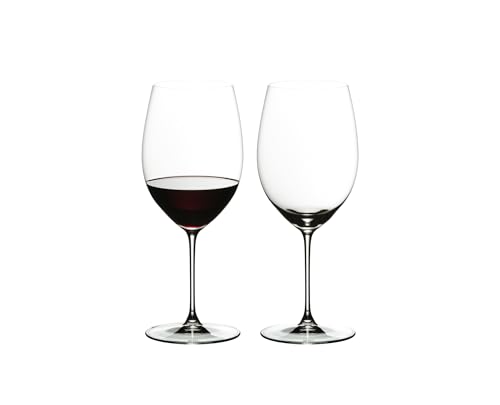
RIEDEL Veritas Cabernet/Merlot Glass

The lightest classic-shaped machine glass Riedel makes, and a near stand-in for hand-blown stemware.

RIEDEL Veritas Cabernet/Merlot Glass
Price
About $35 a glass (sold in value packs) (Amazon today: $88.10)
Made in
Germany
Keeps for
Years of dishwasher use
Material
Machine-blown crystal glass
Height
About 9.25 in
Made
Germany
Dishwasher
Yes (maker)
Sold as
Value packs of 4 at riedel.com

Riedel launched Veritas in 2014 as a machine-blown glass meant to feel like handmade stemware. It is thinner and taller than Riedel's older Vinum line, and the Cabernet/Merlot shape is the big, traditional Bordeaux bowl you picture when you picture a wine glass. It is made in Riedel's Bavarian factories.

Riedel rates all of Veritas as dishwasher safe. The Cabernet/Merlot is the one to own if you want a single glass; the Riesling/Zinfandel is a better white-wine glass but too small for big reds. Riedel's own store sells it in buy-three-get-four value packs, which brings the per-stem price down.

Skip it if you have a small cabinet. At over nine inches tall, it does not fit on every shelf, and the long stem is where machine-made glasses tend to snap during hand drying.

The catch. Tall enough to be awkward in a standard dishwasher rack and on low shelves.

No. 05If money is no object

Zalto

Zalto Denk'Art Universal Glass

The mouth-blown glass sommeliers reach for, and a genuine pleasure, at a price that makes every breakage count.

Zalto Denk'Art Universal Glass
Price
About $75 to $80 a glass (Amazon today: $78.00)
Made in
Austria
Keeps for
As long as you do not break it, which is the whole question
Material
Mouth-blown lead-free crystal
Capacity
About 530 to 555 ml
Height
About 235 mm (9.3 in)
Made
Neunagelberg, Austria
Dishwasher
Yes; maker prefers it to hand washing

Zalto glasses are blown by hand at the Zalto glassworks in Neunagelberg, Austria, near the Czech border, in lead-free crystal. The Denk'Art line takes its name from Hans Denk, the priest and wine thinker who helped design the shapes, and the bowls break at angles of 24, 48 and 72 degrees.

The Universal holds about 530 to 555 ml and stands roughly nine inches tall. It is very thin at the rim and very light, and it suits nearly any still wine. Zalto recommends the dishwasher over hand washing, because twisting the bowl against the stem while drying by hand is how most of them break.

Skip it if you have children, a dog with a tail, or a small sink. It is not fragile in the dishwasher so much as unforgiving everywhere else, and at nearly $80 a stem you will notice every loss.

The catch. The price of a single breakage is the price of a good bottle of wine.

Dishwasher-safe crystal versus hand-blown

Modern lead-free crystal glass, whether machine made or mouth blown, is rated for the dishwasher by nearly every maker here. What clouds glasses is usually too much detergent and too much heat, not the machine itself. Use less detergent than the box suggests, skip the heated dry, and open the door once the cycle ends.

The real difference between machine-made and hand-blown is weight and rim thickness. A mouth-blown glass is thinner and lighter because a person, not a mold, sets the wall. That thinness makes it more pleasant and more breakable, and most breakage happens by hand, when you hold the bowl and twist the base while drying.

Buying enough

Buy more than you think. If you seat eight, own twelve. Glasses break a few at a time, and a line can be discontinued or reshaped. Buying a spare set now is cheaper than trying to match later.

What to avoid

Skip thick-rimmed glass sold as crystal, stemless tumblers for anything better than weeknight wine (your hand warms it), and colored or cut glass for drinking wine. You want to see what is in the glass.

Questions.

Do I need separate red and white wine glasses?

No. A universal bowl of about 500 ml serves both well. If you drink a lot of white, a second, smaller glass is a nice extra, not a requirement.

Can crystal glasses really go in the dishwasher?

Modern lead-free crystal from Spiegelau, Schott Zwiesel, Riedel, Gabriel-Glas and Zalto is rated dishwasher safe by the makers. Older leaded crystal and most cut crystal should still be washed by hand.

What is Tritan crystal?

It is Schott Zwiesel's lead-free crystal glass, which uses titanium instead of lead. The maker designs it to resist chipping, scratching and breaking.

Is a Zalto worth three times a Gabriel-Glas?

For wine, the difference is small. For the feel in the hand, it is real. If you break glasses regularly, buy the cheaper one and more of them.

How many should I buy?

Enough to seat your largest regular table, plus a third more for breakage and spares.

Sources.

  1. Gabriel-Glas North America: StandArt
  2. Gabriel-Glas North America: FAQ
  3. Zalto: Denk'Art collection
  4. Zalto: glass care
  5. Riedel: Veritas Cabernet/Merlot
  6. IWA Wine Accessories: Zwiesel Glas

More from Glass.

01The home bar tools and glasses worth owning.