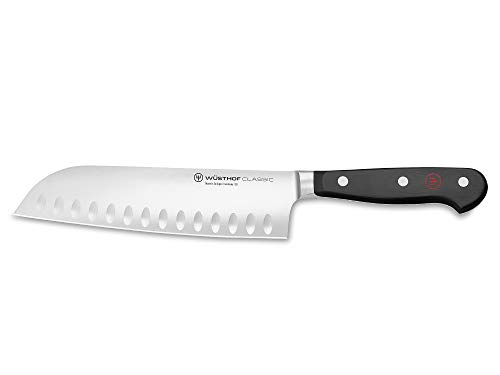
The santoku
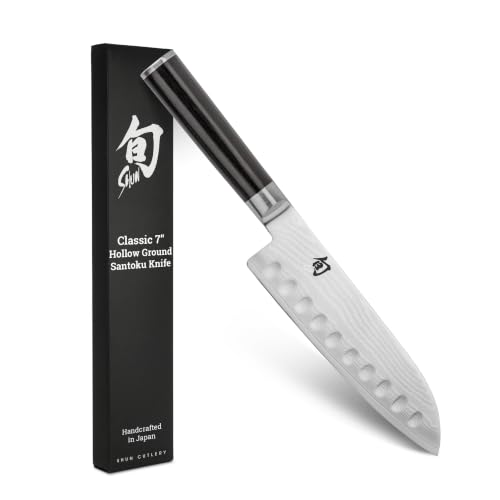
They look like cousins and share the same steel. One is a general-purpose knife with a short blade. The other is a cleaver-shaped tool that does one thing faster than anything else in the drawer.
Tap either one to check today’s price.
The santoku
The nakiri

Shun Classic 7" Hollow Ground Santoku Knife has the edge on 3 of 10 lines, Shun Classic Blonde 6.5" Nakiri Knife on 0, 4 even.
| Feature | Shun Classic 7" Hollow Ground Santoku Knife | Shun Classic Blonde 6.5" Nakiri Knife |
|---|---|---|
| Blade shape | Spine curves down to meet a fairly flat edge; a sheepsfoot profile | Rectangular: flat spine, flat edge, squared-off end |
| Tip | A rounded point, usable for light detail work (the edge) | None; the end is square |
| Blade length | 7 in (178 mm) | 6.5 in (165 mm) |
| Cutting motion | Push cuts, with a little rock at the heel | Straight down, no rocking; the whole edge meets the board at once |
| SteelEven | VG-MAX core, 68-layer Damascus cladding | VG-MAX core, 68-layer Damascus cladding |
| Edge angleEven | 16 degrees per side | 16 degrees per side |
| Edge grind | Hollow ground: scallops that help slices fall away (the edge) | Plain |
| HandleEven | D-shaped ebony PakkaWood | D-shaped blonde PakkaWood |
| Price on Amazon | About $130 (the edge) | About $190 |
| Made inEven | Japan | Japan |
The verdict
Buy the santoku if you want one Japanese knife for vegetables, boneless meat and fish; it does most of what a chef's knife does in a shorter, lighter blade. Buy the nakiri only if vegetables are most of your prep and you cut straight down. For that one job it is the faster, cleaner knife, and for nearly everything else it is the wrong one.
The knife set for home cooks.The chef's knife for under $100.The carving set for the holiday roast.
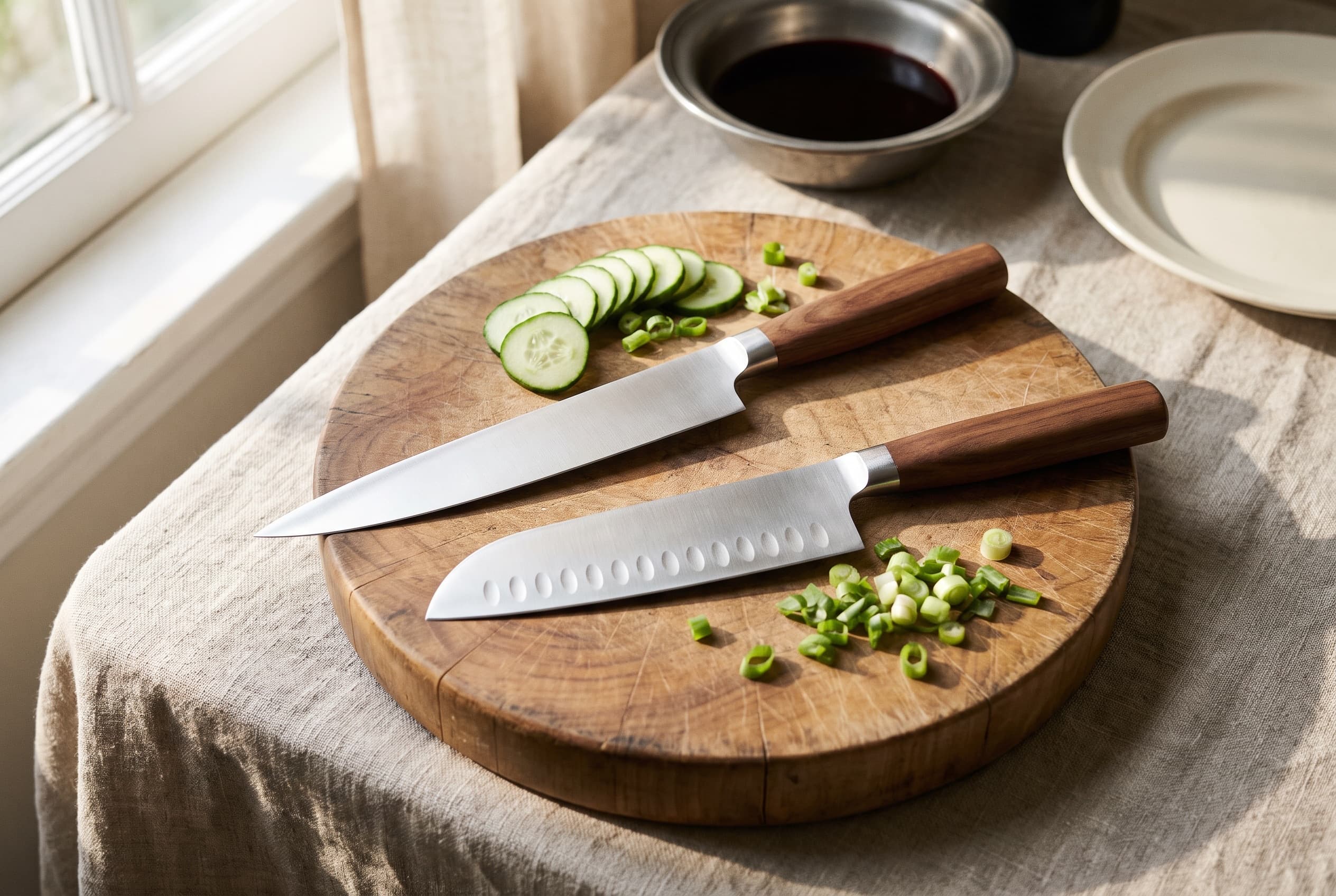
A santoku is Japan's all-purpose kitchen knife. The name is usually translated as three virtues, for slicing, dicing and mincing, and the shape is a fairly flat edge with a spine that curves down to a modest point. A nakiri is a vegetable knife: a thin rectangular blade with a flat edge and no point at all, made to drop straight through produce without rocking.
To keep the comparison fair, both knives here come from the same maker and the same line. Shun's Classic 7 inch hollow-ground santoku and Classic 6.5 inch nakiri are both built on a VG-MAX core wrapped in 68 layers of stainless Damascus, both sharpened to 16 degrees per side, both finished with a D-shaped PakkaWood handle and handcrafted in Japan. The nakiri's handle is the blonde version; the blade is the same. What changes is the shape, and the shape changes how you move your hand.
The short version: the santoku is the knife to buy if you are buying one. The nakiri is the knife to add if you find yourself prepping a pile of vegetables several nights a week and your chef's knife feels like the wrong tool for it. For the German-versus-Japanese question, our chef's knife vs santoku comparison covers the other side.
The Japanese all-rounder: a 7 inch blade with a fine 16 degree edge and scallops that keep potato slices from clinging.
Shun's Classic santoku is a 7 inch, 178 millimeter blade with a VG-MAX cutting core clad in 34 layers of stainless Damascus on each side, ground to a 16 degree edge on each side. The hollow-ground version adds a row of shallow indentations above the edge that Shun says reduce friction so the blade glides through food, which in practice means slices of cucumber and potato fall away instead of riding up the blade. Shun lists it at 7.1 ounces with a 5 inch D-shaped ebony PakkaWood handle, handcrafted in Japan. When it was introduced, Blade Magazine named it Kitchen Knife of the Year.
The profile is what makes it general-purpose. The edge is flat enough for a straight push cut through an onion, the spine curves to a point that will core a pepper or trim a chicken thigh, and the 7 inch length is short enough to feel precise on a small board. It handles boneless meat and fish as happily as vegetables.
Skip it if you rock-chop herbs by habit or break down whole birds; a Western chef's knife does both better. And treat the edge with respect: 16 degrees is fine and hard, so no bones, no frozen food, no twisting in a squash.
The catch. A fine, hard edge that chips if it meets bone or a frozen block.
Where to buy
AmazonCheck price →The same steel and edge in a rectangular blade that drops straight through vegetables, and does little else.
This is the Classic nakiri with Shun's blonde PakkaWood handle: a 6.5 inch, 165 millimeter rectangular blade on the same VG-MAX core and 34-layer-per-side Damascus cladding as the santoku, ground to the same 16 degrees per side. Shun lists it at 7.6 ounces, a little heavier than the santoku because the blade carries its full height all the way to the end. The ebony-handled version is the same knife; at the time of writing it was not sold by Amazon itself, which is why the blonde is here.
Shun describes the nakiri as a knife for push cuts rather than rocking, and that is exactly how it feels. The edge is dead flat, so the whole length meets the board at once and nothing gets left hinged at the bottom of a slice. The tall blade keeps knuckles clear and scoops what you have cut. On a pile of carrots, cabbage or scallions it is faster and cleaner than any santoku or chef's knife.
Skip it as a first knife. There is no point for coring, trimming or scoring, the short flat blade is awkward on meat, and it is $60 more than the santoku. Buy it as a second knife for a vegetable-heavy kitchen.
The catch. No tip, no rocking, and the wrong knife for meat; a specialist that costs more than the generalist.
Where to buy
AmazonCheck price →The Western all-purpose knife: longer, pointed, and sturdy enough for the jobs both Japanese shapes refuse.
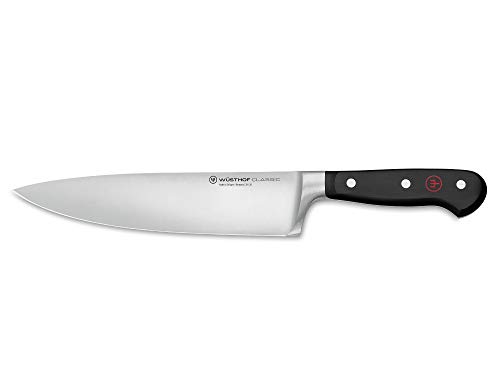
The Classic 8 inch is forged from one piece of high-carbon stainless steel, hardened to 58 HRC, with a full bolster and a triple-riveted synthetic handle. The listing gives an 8 inch blade, a 5 inch handle and a weight of 8.5 ounces, made in Solingen. Wusthof sharpens its Western knives to about 14 degrees per side, a touch sturdier than Shun's 16 on softer steel.
It rocks through parsley, carves a chicken, and goes through a butternut squash without the owner worrying about the edge. If one knife has to do everything, this is the shape. Our chef's knife vs santoku comparison sets it against Wusthof's own santoku.
The catch. Long and heavy on a small board, and the full bolster complicates sharpening over the years.
Where to buy
AmazonCheck price →A stamped Swiss santoku with the same scalloped edge for less than half the Shun's price.
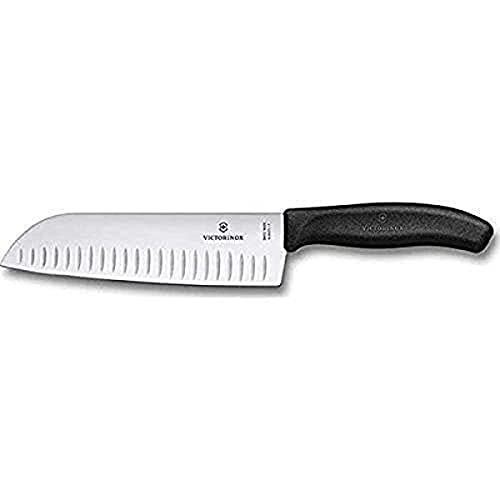
Victorinox stamps this santoku from stainless steel in Switzerland, with a Granton edge (the same idea as Shun's hollow grind) and a textured Fibrox handle made for wet hands. The listing says it has been made in Switzerland since 1884, is built for professionals who use knives all day, and carries a lifetime warranty against defects in material and workmanship. Victorinox lists the blade at 6.7 inches and calls the knife dishwasher safe, though hand washing keeps any edge longer.
It is softer steel than the Shun, so it dulls faster and sharpens more easily, and it will never look like a Damascus blade. For a cook who wants to find out whether the santoku shape suits them before spending $130, it is the obvious way to find out.
The catch. Softer steel that needs more frequent sharpening, and a utilitarian look.
Where to buy
AmazonCheck price →A nakiri's flat edge is meant to land on the board along its whole length. Lift, move forward, drop. There is no rocking because there is no curve to rock on, and no accordion-cut slices left hanging by a thread. A santoku keeps most of that flatness but adds a little curve toward the point, so it can do a short rock at the heel and use the tip for trimming.
If you catch yourself rocking a nakiri, you are fighting it. If you catch yourself wishing a santoku were taller or flatter on a big pile of cabbage, you have found the reason to own a nakiri.
Both knives here use the same VG-MAX core, the same Damascus cladding and the same 16 degree edge. Shun does not publish a Rockwell hardness on its product pages; retailers list the Classic line at about 60 to 61 HRC, which is harder than a German knife and the reason the edge is finer. Shun also sharpens both free for life through its sharpening service; you pay return shipping.
Bones, frozen food, glass or stone boards, and the dishwasher. A 16 degree edge on hard steel chips rather than rolls. Hone on a ceramic rod or a fine stone, never a grooved steel meant for German knives.
For vegetables cut straight down, yes. For everything else, no. The santoku has a point, handles boneless meat and fish, and costs less; the nakiri is a specialist.
Boneless meat, yes, though the short flat blade is clumsy for trimming and it has no tip for scoring. Never bones. A santoku or chef's knife is the better choice for meat.
Slicing, dicing and mincing: the three virtues in the name. It is Japan's general-purpose kitchen knife, used for vegetables, fruit, boneless meat and fish.
The santoku is longer at 7 inches against the nakiri's 6.5. The nakiri is taller along its whole length and a little heavier; Shun lists 7.6 ounces for the nakiri and 7.1 for the santoku.
Most cooks do not. Buy the santoku, or a chef's knife, first. Add the nakiri if vegetable prep is most of your cooking.
 KitchenAll-Clad vs Demeyere: Which Stainless Pan to Buy
 KitchenCarbon Steel Pan vs Stainless Steel: Which to Buy
 KitchenIs All-Clad Worth It? Compared With a $50 Tri-Ply
 KitchenThe Best Cookie Sheets and Silicone Baking Mats
 KitchenBest Cutting Board: End Grain vs Edge Grain Wood
 KitchenQuality Knife Sets for Home Cooks: Block vs Three Knives
 KitchenMeat Thermometer Price Comparison: Instant-Read vs Leave-In
 KitchenHexClad vs Henckels Paradigm: Which Hybrid Pan to Buy
The Bonwits Letter
What is worth buying for the house this week, what is actually on sale, and what to skip. Short, and never sponsored.