Bonwits

The knife sharpener that keeps a good knife good.

A good knife is only as good as its last sharpening. Most households need two tools: something to hone with weekly, and something to sharpen with a few times a year.

By the Bonwits editors
Updated September 26, 2026
6 picks
Save to Pinterest
The knife sharpener that keeps a good knife good

The short list.

6 picks. Tap any to check today’s price.

  1. The one to use every week
    WÜSTHOF 9" Honing Steel

    No. 01Wusthof

    WÜSTHOF 9" Honing Steel

    $35 on Amazon today

  2. The rod for harder knives
    WÜSTHOF 10" Ceramic Sharpening Rod

    No. 02Wusthof

    WÜSTHOF 10" Ceramic Sharpening Rod

    $65 on Amazon today

  3. The one to buyOur pick
    Shun Combined Whetstone Sharpener, 1000 & 6000 Grit
  4. The honest entry point
    Chef'sChoice Manual Knife Sharpeners for 15- and 20-Degree Straight-Edge and Serrated Knives, Gray
  5. If you will never learn a stone
    Chef'sChoice Professional Electric Knife Sharpeners AngleSelect for 15- and 20-Degree Straight-Edge and Serrated Knives, Metallic
  6. The complete kit
    Shun Cutlery 3 Piece Whetstone Sharpening System

Before you buy

Read this first.

Picks
6
Price range
$35 to $155
Updated
September 26, 2026

Honing and sharpening are different jobs, and most dull knives are dull because nobody knows it. Honing pushes a bent edge back into line and removes almost no metal. Sharpening grinds a new edge. Shun puts it plainly on its own service page: sharpening removes metal, honing brings the edge back to true. A knife honed every few uses needs sharpening far less often.

So the question is not which sharpener to buy, but which pair. A rod for the week and a stone or machine for the season. The rod is cheap and fast. The stone is slow, quiet and the gentlest on steel, and it asks for twenty minutes and a little practice. The machine asks for neither, and takes more metal off to make up for it.

Everything below is sold on Amazon by Amazon.com itself. The picks run from a $35 steel to a whetstone kit at about $155. Match the tool to your knives and your patience, and keep the sharpener away from anyone who treats it as a toy.

What we judged on.

4 tests, applied to every pick below

  1. 01

    Honing or sharpening

    A rod realigns an edge between sharpenings. A stone or a diamond wheel grinds a new one. Most kitchens need one of each.

  2. 02

    Angle

    German knives are usually sharpened near 20 degrees per side on older blades and about 14 to 15 on newer ones; Japanese knives run about 15 to 16. The tool has to match the knife.

  3. 03

    Metal removed

    Stones take off the least for the edge they give. Pull-through and electric sharpeners are faster and less forgiving of hard, thin steel.

  4. 04

    Skill asked

    Whether you will actually use it. A whetstone in a drawer sharpens nothing.

No. 01The one to use every week

Wusthof

WÜSTHOF 9" Honing Steel

A plain grooved steel from Solingen that keeps a German knife cutting between sharpenings.

WÜSTHOF 9" Honing Steel
Price
About $35 (Amazon today: $35.00)
Made in
Germany
Keeps for
Decades; the maker covers it with a lifetime warranty
Length
9 in
Material
High carbon stainless steel, 58 HRC
Surface
Grooved, magnetic
Handle
Textured, with protective bolster
Warranty
Lifetime (listing)

This is the tool that does the most for the least. Wusthof forges the rod from high carbon stainless steel tempered to 58 HRC, the same hardness it lists for its Classic knives, and cuts light grooves along its length. The rod is magnetic, so the fine particles it lifts off the edge stay on the steel rather than your food.

Use it every few times you cook. Hold the knife at about its edge angle, draw it down the rod a few times on each side, lightly, and the edge comes back into line. Nine inches is enough for an eight inch chef's knife and short enough for a drawer.

Skip it for hard Japanese knives around 60 HRC and above. A grooved steel as hard or softer than the blade does little, and the grooves can chip a thin, hard edge. Those knives want the ceramic rod or a fine stone.

The catch. Hones only. It will not bring back a knife that is truly dull.

No. 02The rod for harder knives

Wusthof

WÜSTHOF 10" Ceramic Sharpening Rod

A ceramic rod that hones and lightly sharpens, safe for Japanese steel that a grooved steel would chip.

WÜSTHOF 10" Ceramic Sharpening Rod
Price
About $65 (Amazon today: $65.00)
Made in
Germany
Keeps for
Decades, unless dropped on a tile floor
Length
10 in
Surface
Ceramic
Best for
Harder Japanese blades and knives past a steel's help
Maker
Wusthof, Solingen

Ceramic is harder than any kitchen knife steel, so a ceramic rod does a little real sharpening as it hones. That makes it the right daily tool for Japanese knives and for German knives that have gone past what a plain steel can fix. Wusthof describes its 10 inch ceramic rod as suited to dull to moderately sharp knives.

The extra inch over the steel above helps with longer blades, and the smooth surface is kinder to thin edges than grooves. Use the same light touch: a few strokes each side, at the knife's own angle, before cooking rather than after.

Ceramic is brittle. A drop onto stone can crack or snap the rod, so hang it or keep it in a block slot. Skip it if every knife in the house is German and in good order; the steel is enough.

The catch. Brittle. One drop on a hard floor can end it.

No. 03The one to buy

Shun

Shun Combined Whetstone Sharpener, 1000 & 6000 Grit

A two-sided water stone: 1000 grit to sharpen, 6000 to polish. The way good knives have always been kept.

Shun Combined Whetstone Sharpener, 1000 & 6000 Grit
Price
About $100 (Amazon today: $99.95)
Keeps for
Years of regular use; the stone wears slowly and needs flattening now and then
Grits
1000 (sharpening) and 6000 (finishing)
Type
Water stone; soak before use
Includes
Rubber tray
Suits
Western and Japanese double bevel knives

A whetstone is the slowest option and the best one. It removes the least metal, works at whatever angle you hold, and handles every knife in the house, German or Japanese. This Shun stone has a 1000 grit side to set the edge and a 6000 grit side to polish it, and comes with a rubber tray that holds it steady on the counter.

Soak it in water first, as Shun directs. Then work the 1000 side until you raise a small burr along the whole edge, switch to the 6000 side, and finish with light strokes. Shun sharpens its own double bevel knives at 16 degrees, a sensible target for most Japanese blades.

The learning curve is real, and the first few sessions are slow. Skip it if you will not give it twenty minutes and some patience. A Shun owner who would rather not learn can use Shun's mail-in service instead, which sharpens free for original owners who bought from authorized dealers, with a $15 processing fee in the US.

The catch. Takes practice, and the stone dishes over time and has to be flattened.

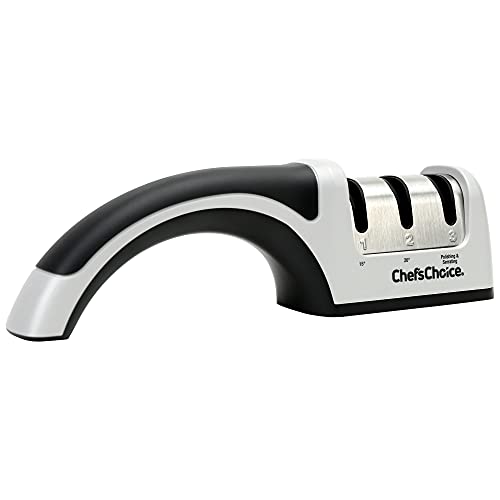
No. 04The honest entry point

Chef'sChoice

Chef'sChoice Manual Knife Sharpeners for 15- and 20-Degree Straight-Edge and Serrated Knives, Gray

A manual pull-through with separate 15 and 20 degree slots, which is more than most pull-throughs can say.

Chef'sChoice Manual Knife Sharpeners for 15- and 20-Degree Straight-Edge and Serrated Knives, Gray
Price
About $60 (Amazon today: $59.69)
Keeps for
Years; the diamond wheels outlast most household use
Type
Manual, pull-through
Angles
15 and 20 degrees
Abrasive
Diamond
Serrated
Yes
Model
4643 ProntoPro

This is the ProntoPro, model 4643, from the Pennsylvania company that has made Chef'sChoice sharpeners since 1984. It uses diamond abrasive wheels in fixed angle guides: one stage for 15 degree Asian style blades, one for 20 degree European and American blades, and a polishing stage that also handles serrated knives.

Most cheap pull-throughs have one fixed angle and carbide blades that tear at an edge. This one lets you match the knife, which matters in a house with both a German chef's knife and a Japanese santoku. A few light pulls restore a working edge.

It still removes more metal than a stone, and it is no tool for single bevel Japanese knives. Skip it if you own one very good knife and are willing to learn a whetstone.

The catch. Faster than a stone, and harder on steel over the years.

No. 05If you will never learn a stone

Chef'sChoice

Chef'sChoice Professional Electric Knife Sharpeners AngleSelect for 15- and 20-Degree Straight-Edge and Serrated Knives, Metallic

An electric sharpener with both angles, for the household that wants sharp knives and no ritual.

Chef'sChoice Professional Electric Knife Sharpeners AngleSelect for 15- and 20-Degree Straight-Edge and Serrated Knives, Metallic
Price
About $130 (Amazon today: $129.99)
Keeps for
Years; carries a 3-year limited warranty on the listing
Type
Electric, 3 stages
Angles
15 and 20 degrees
Abrasive
Diamond; stropping disks in stage 3
Weight
About 4.4 lb (maker)
Warranty
3-year limited (listing)

The 1520 AngleSelect has three stages. The first sharpens 15 degree knives, the second 20 degree knives, and the third uses flexible stropping disks to polish either. Chef'sChoice says a first sharpening takes about a minute and a touch up about ten seconds.

That speed is the point. It turns sharpening from a project into something done before a dinner party, and the precision guides hold the angle from heel to tip. It handles serrated knives in the last stage and weighs about 4.4 pounds, so it sits on a shelf rather than in a drawer.

The trade is metal. A motorized diamond wheel takes off more steel than a stone, and a heavy hand shortens a knife's life. Skip it for expensive single bevel or very hard Japanese blades, which belong on a stone or with the maker's service.

The catch. Removes more steel than a stone. Use light pressure and few passes.

No. 06The complete kit

Shun

Shun Cutlery 3 Piece Whetstone Sharpening System

The same 1000/6000 stone plus a combination honing steel and a bamboo stand: the whole routine in one box.

Shun Cutlery 3 Piece Whetstone Sharpening System
Price
About $155 (Amazon today: $154.95)
Keeps for
Years; the steel lasts decades, the stone wears slowly
Stone
1000 and 6000 grit combination
Steel
9 in stainless, smooth and micro-ribbed sides
Stand
Angled bamboo
Care
Soak stone before use

If you are buying a stone and a rod anyway, this is the tidy way to do it. The kit pairs Shun's 1000/6000 combination whetstone with a 9 inch stainless honing steel and an angled bamboo stand that holds both.

The steel has a smooth side and a finely ribbed side. Shun's listing suggests the smooth side weekly and the ribbed side monthly, which suits Shun's harder blades better than a coarse grooved steel would. The stand helps with angle as you hone.

Skip it if you already own a ceramic rod, or if your knives are all German; the Wusthof steel and the stone alone cost less and do the same job.

The catch. You pay about $55 over the stone alone for a steel and a stand.

How often

Hone a German knife every few uses, and a Japanese knife lightly and less often, on ceramic. Sharpen when the knife slides off a tomato skin instead of biting, which for a home cook is two to four times a year.

If you hone and it still slips, honing is no longer enough. That is the day for the stone.

Matching angle to knife

Check what your maker uses. Wusthof sharpens its Classic knives at 14 degrees per side, Shun at 16. Older and cheaper German knives are often near 20. Sharpening a Japanese knife at 20 degrees does it no harm but gives up the edge you paid for.

What to skip

Five dollar pull-throughs with carbide V notches, which scrape rather than sharpen. Grooved steels on hard Japanese blades. Any sharpener on a single bevel knife unless it is a stone, or the maker's own service.

Questions.

What is the difference between honing and sharpening?

Honing straightens an edge that has bent over in use and removes almost no metal. Sharpening grinds a new edge. Hone often, sharpen a few times a year.

Do I need a whetstone?

No, but it is the gentlest and most versatile way to sharpen. If you will not practice, a good two-angle sharpener or a mail-in service is the better choice.

What grit whetstone should I buy first?

A combination 1000/6000 stone. The 1000 side sharpens, the 6000 side polishes, and together they cover almost all household knives.

Are electric knife sharpeners bad for knives?

They remove more metal than a stone, so heavy or frequent use shortens a blade's life. With light pressure and the right angle they are fine for most kitchen knives. Keep expensive Japanese blades off them.

Can I use a honing steel on a Japanese knife?

A grooved steel is a poor match for hard Japanese steel and can chip it. Use a ceramic rod or a smooth steel, with a light touch.

Sources.

  1. Shun, sharpening service and honing guidance
  2. Wusthof, 9" Honing Steel
  3. Wusthof, 10" Ceramic Sharpening Rod
  4. Chef'sChoice, AngleSelect Model 1520
  5. Chef'sChoice, ProntoPro Model 4643

The Bonwits Letter

One good email, on Sundays.

What is worth buying for the house this week, what is actually on sale, and what to skip. Short, and never sponsored.

Unsubscribe any time. We never share your address.

More from Kitchen.

01The pour-over coffee setup.02The saucepan you buy once.03The sheet pan and the baking dish.04The cast iron skillet that outlives you.